The streaming industry has become obsessed with FAST Channels. However, the FAST Channels low audience is clear from viewing patterns.
Most viewing on many ad-supported platforms occurs on AVOD and on-demand content, not linear FAST television. The FAST channels that attract audiences share live entertainment, live sports, live news and exclusive programming.
There is a rather uncomfortable truth emerging in the Connected TV industry.
FAST Channels are not necessarily where the majority of viewing happens.
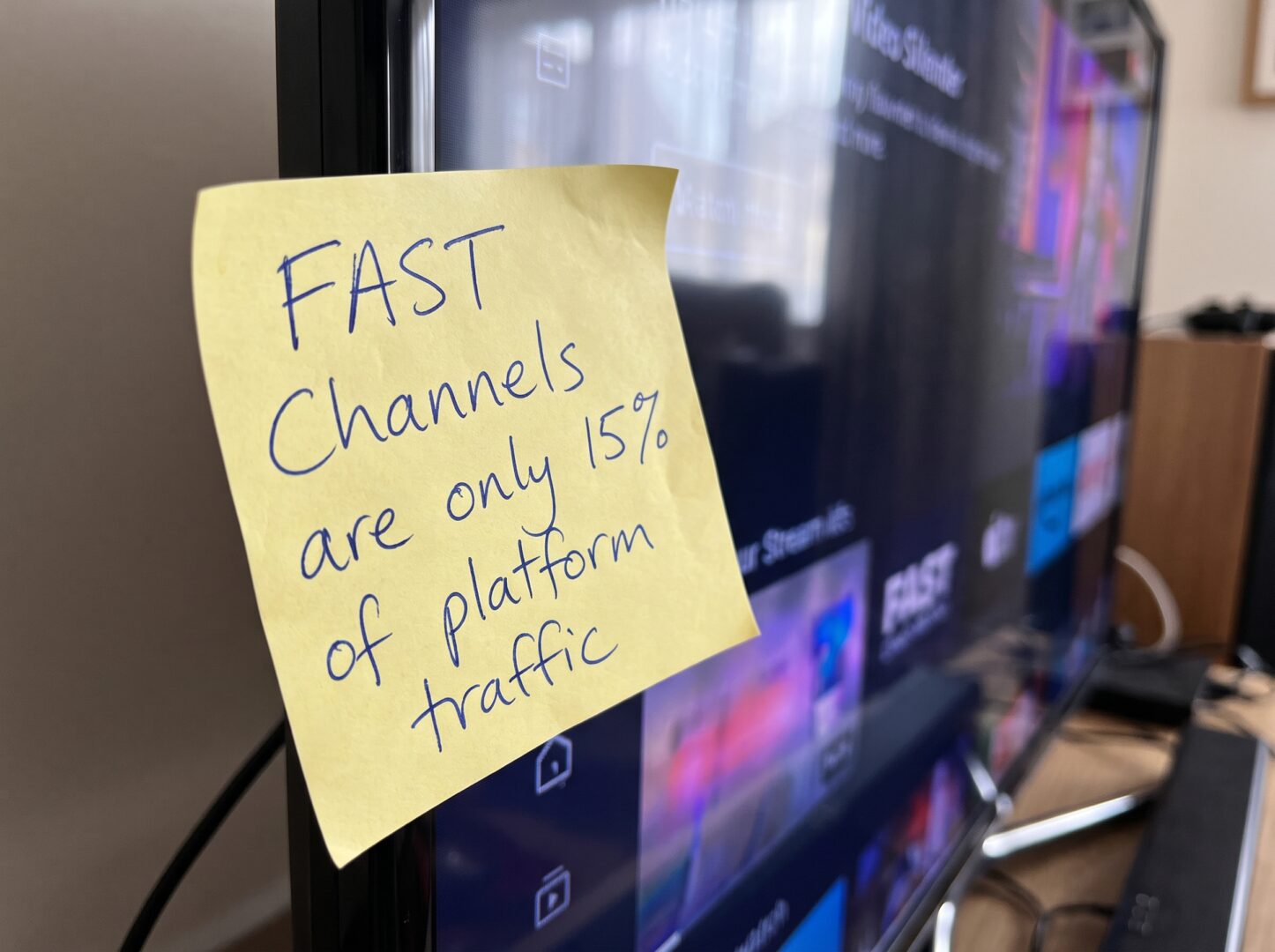
Across many ad-supported streaming services, linear FAST channels account for a relatively small proportion of total viewing.
Figures around 15% are often cited in industry discussions, reflecting FAST Channels low audience.
The majority of viewing is happening through AVOD and on-demand programming.
The exact split varies considerably between platforms, territories, audiences and measurement methodologies. However, the commercial message is clear: viewers do not automatically want to watch a television channel simply because somebody has created one.
Nevertheless, the industry continues to encourage studios, distributors and content owners to launch hundreds of new FAST Channels. They often use libraries of content that have little audience demand, no meaningful programming strategy and very little differentiation.
We seem to have confused the ability to create a television channel with the ability to create an audience.
They are two very different things.
The FAST Channel Gold Rush Has Created a Content Problem
For the last few years, the industry has been selling the dream of FAST.
Take an existing content library, put it into a playlist, add some advertising breaks, connect it to a distribution platform and suddenly you have a television network.
Technically, that might be true.
Commercially, it is a different story.
The industry has made it incredibly easy to launch FAST Channels, but it has not made it easy to build successful television businesses.
We now have platforms carrying hundreds, sometimes thousands, of channels, many competing for the same limited audience.
A library of old television programmes does not automatically become a compelling television channel.
A collection of documentaries does not automatically become a destination.
And putting 500 episodes of unrelated content into a playlist does not create a programming strategy.
The problem is not a shortage of FAST Channels. It is a shortage of reasons to watch them.
Why Is AVOD Winning More Viewing Hours?
AVOD gives viewers something that FAST frequently does not: control.
They can choose a programme, select a movie, watch a series, find something specific and continue watching content that interests them.
There is no requirement to join a linear schedule or wait for a particular programme to appear.
This is particularly important when considering how audiences have changed their viewing habits.
People increasingly expect television to work around their interests rather than expecting their interests to work around television schedules.
AVOD also allows content owners to monetise individual titles, franchises, episodes and libraries without having to build an entire linear channel around them.
For studios and distributors, this creates a much broader opportunity.
Instead of asking whether a library can fill a 24-hour channel, the better question is:
How many hours can this content generate when presented to the right audience, at the right time, through the right experience?
That is a much more useful commercial conversation.
So What FAST Channels Do People Actually Want to Watch?
This is where the industry needs to start thinking differently.
Linear television is not dead. In fact, certain types of programming remain particularly well suited to scheduled viewing.
But there is a reason people still turn on traditional television.
They want something happening now.
They want to be entertained without having to search through endless menus.
They want to follow events, watch something exclusive or become part of a shared viewing experience.
The FAST Channels with the strongest proposition are often built around four areas.
1. Live Entertainment
Live entertainment creates appointment viewing.
Concerts, talent competitions, comedy, reality formats, special events and live performances give audiences a reason to tune in at a particular time.
Unlike an endless loop of old episodes, live entertainment creates an immediate reason to watch.
It also provides opportunities for sponsorship, branded entertainment and advertising integrations that go beyond traditional commercial breaks.
2. Live Sports
Sports is one of the most obvious reasons people continue to watch linear television.
Sports audiences follow teams, competitions, events and personalities. They want the action as it happens.
Live sports also creates repeat viewing, predictable programming windows and valuable advertising opportunities.
Not every FAST Channel needs to carry the Premier League or the NFL.
There are thousands of opportunities in niche sports, emerging competitions, motorsport, pickleball, tennis, combat sports, amateur leagues and specialist sporting communities.
The opportunity is not simply to broadcast sport.
It is to build a destination around an audience that genuinely cares about it.
3. Live News
News is inherently time-sensitive.
People do not necessarily want yesterday’s news packaged into a 24-hour loop when they can access on-demand clips elsewhere.
They want updates, breaking stories, live coverage, analysis and commentary.
A properly programmed news channel provides a reason to return throughout the day.
It is one of the strongest natural applications for linear television because the content is constantly changing.
4. Exclusive Content
This is arguably the biggest opportunity.
Why would somebody watch your FAST Channel instead of another channel, YouTube, Netflix or an AVOD service?
What do you have that they cannot find somewhere else?
Exclusive programming, original formats, first-run content, specialist communities and recognisable personalities give a channel an identity.
Without differentiation, a FAST Channel is simply another entry in an increasingly crowded electronic programme guide.
Distribution is not a competitive advantage when everybody has access to the same distribution. Content and audience relationships are.
Stop Building Channels Around Weak Content Libraries
The industry needs to stop treating every content library as an opportunity to create a FAST Channel.
Some libraries are perfectly suited to AVOD.
Some are better suited to SVOD.
Some should be licensed directly to platforms.
Others may justify a linear channel because they have the depth, quality, exclusivity and audience demand to support scheduled programming.
The mistake is trying to force everything into a television channel.
A library of 200 hours of mediocre content does not become more valuable because it is spread across a 24-hour schedule.
In fact, it can make the content look worse.
Audiences have become accustomed to enormous libraries of professionally produced entertainment. They can access films, series and specialist programming across multiple platforms.
The competition is no longer another FAST Channel.
It is every other entertainment option available on the television.
This is why content curation, programming and quality matter.
I would rather see 50 genuinely compelling television channels than 1,000 channels that nobody has a reason to watch.
Traditional cable television understood something that the FAST industry seems to have forgotten: people build habits around channels they actually want to watch.
The Economics: Hours Viewed Are More Important Than Channel Counts
There is far too much emphasis on how many channels a platform carries.
How many channels have you launched?
How many channels are available?
How many content partners have you signed?
These are distribution metrics, not commercial outcomes.
The question should be how many hours are being watched and how much revenue those hours generate.
For broadcasters and content owners, the economics should be straightforward:
Hours Viewed × Revenue Per Thousand Hours (RPM) = Revenue
A channel generating 100,000 hours of viewing is not necessarily more commercially valuable than an AVOD library generating 500,000 hours.
Likewise, a specialist sports channel with a smaller but highly engaged audience may be more valuable than a generic entertainment channel with substantially more passive viewing.
The industry needs to move away from celebrating channel counts and start measuring audience consumption and monetisation.
More channels do not necessarily mean more revenue.
More content does not necessarily mean more viewing.
And more distribution does not necessarily mean a better business.
The Future Is Not FAST Versus AVOD. It Is Both, Used Properly.
There is no reason broadcasters should have to choose between FAST and AVOD.
The smartest approach is to understand which content belongs in which environment.
A television studio with 10,000 hours of programming could operate an AVOD library while also building selected linear channels around its strongest franchises, genres and audience interests.
A sports rights holder could offer on-demand highlights and full replays alongside a linear channel broadcasting live events, analysis and original programming.
A news organisation could offer individual news clips and documentaries through AVOD while maintaining a live news channel.
A film studio could monetise its movie library on demand while creating a curated movie channel around particular genres, franchises or seasonal programming.
The same content assets can potentially generate multiple revenue opportunities, provided the rights and distribution arrangements allow it.
This is where the next generation of streaming television needs to go.
Not simply launching more channels, but building an intelligent content monetisation strategy.
View TV: Better Television, Not Just More Television
At View TV, we believe the industry needs to rethink how it approaches content, distribution and monetisation.
The objective should not be to create as many FAST Channels as possible.
It should be to build television businesses that attract audiences and generate sustainable revenue.
That means looking at the entire ecosystem:
- Content: Quality programming that audiences actually want to watch.
- Audience: Understanding what people watch, how long they watch and why they return.
- Revenue: Monetising viewing through advertising, sponsorship, brand integration and other commercial opportunities.
- Technology: Delivering content efficiently through AVOD, FAST, CTV and other streaming environments.
We call this the CART approach: Content, Audience, Revenue and Technology.
It is a more sensible way to approach the business than starting with a channel launch and hoping an audience appears.
View TV supports broadcasters, studios and content owners with the technology and commercial infrastructure to distribute and monetise television across linear streaming and on-demand environments.
Because ultimately, the industry does not need another thousand FAST Channels.
It needs better television.
The Bottom Line: Stop Filling Electronic Programme Guides. Start Building Audiences.
FAST is a delivery model, not a content strategy.
AVOD is not the enemy of linear television. It is another way of monetising content.
The future belongs to companies that understand the difference between having a content library and having something people actually want to watch.
Build FAST Channels around live entertainment, live sports, live news, exclusive programming and genuinely compelling content.
Use AVOD to monetise the rest of the library where on-demand viewing makes more sense.
Stop building channels simply because the technology makes it easy.
Hollywood does not have a distribution problem. It has an audience and content monetisation problem.
And creating another 500 weak FAST Channels is not going to solve it.
View TV | Building the Next Generation of Streaming Television.