Protect content rights.
Additionally, Dynamic Content Substitution automates regional programming changes and distributes compliant television channels across streaming platforms.
All this can be achieved without rebuilding your entire broadcast operation.
The television industry is undergoing a major transformation. Local television broadcasters, cable operators and satellite television providers are increasingly looking to extend their existing linear television channels onto Connected TV (CTV), OTT and Free Ad-Supported Streaming TV (FAST) platforms.
However, there is a significant challenge when taking an existing television channel and simulcasting it across streaming platforms: not all content licensed for traditional television broadcasting is automatically licensed for internet streaming, OTT distribution or nationwide streaming audiences.
A programme, sporting event, film, television series or syndicated broadcast may have distribution rights limited by territory, platform, transmission method or contractual window.
This creates a problem for broadcasters who want to distribute their existing Electronic Programme Guide (EPG) line-ups across Roku, Samsung TV Plus, LG Channels, VIZIO WatchFree+, Amazon Fire TV and other streaming television services.
The solution is Dynamic Content Substitution from View TV Cloud.
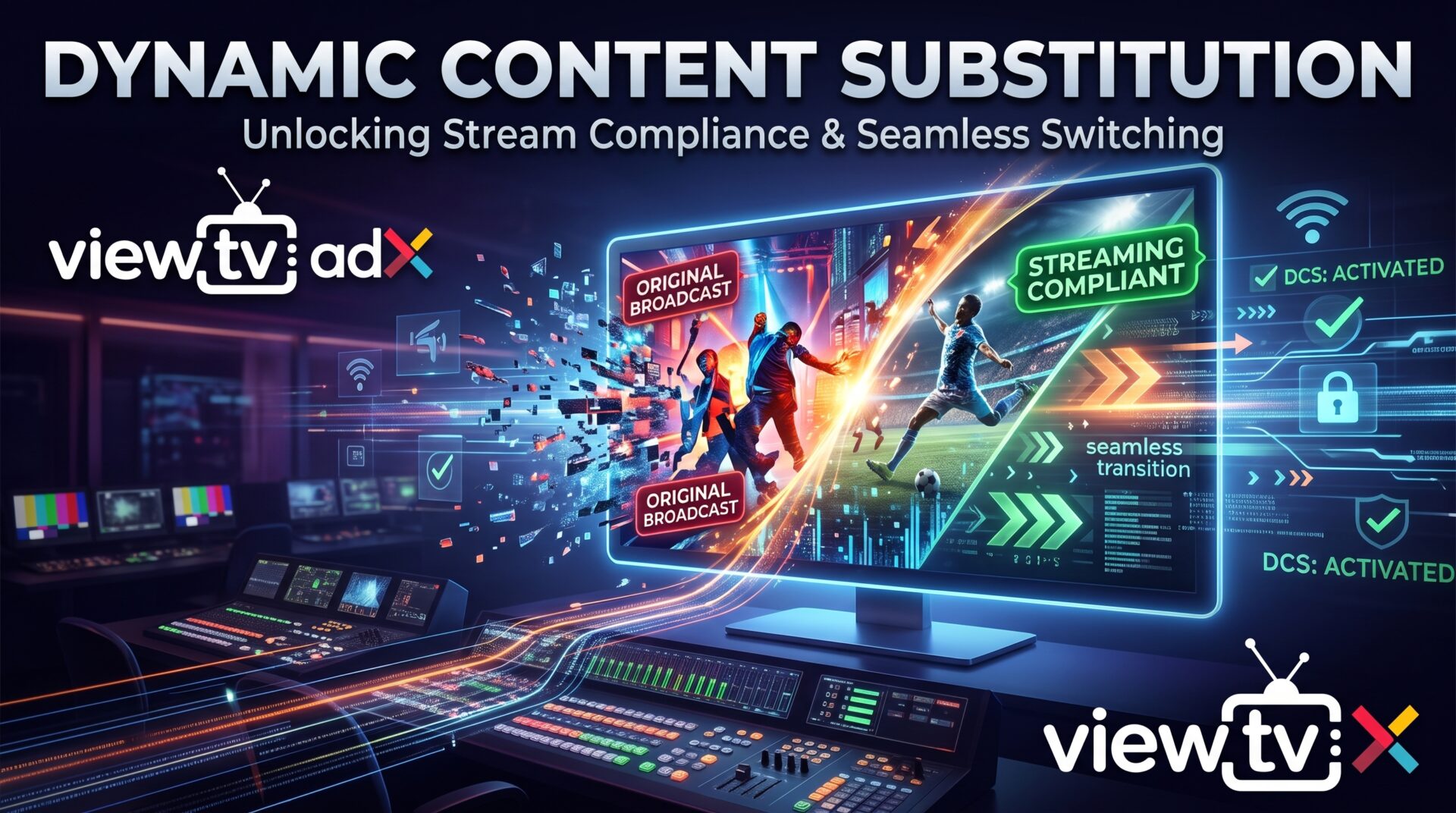
What Is Dynamic Content Substitution?
Dynamic Content Substitution is the automated process of identifying, removing and replacing specific programming within a live or scheduled television channel when that content is not licensed for distribution in a particular territory or through a particular distribution platform.
Rather than creating an entirely separate television channel, manually rebuilding an EPG schedule or operating multiple broadcast playout systems, View TV Cloud enables broadcasters to create alternative versions of their existing channel feeds.
When a programme is identified as unavailable for a particular territory or distribution platform, View TV Cloud can automatically substitute the restricted programme with approved alternative content.
This could include:
- Alternative television programming.
- Licensed film and television content.
- Regional news and local programming.
- Promotional material and channel trailers.
- Approved advertising-supported programming.
- Replacement programming from an existing content library.
- A designated holding slate or broadcaster message.
The result is a more efficient way to manage content licensing restrictions while maintaining a continuous television service.
The Problem: Traditional Television Rights Do Not Always Translate to Streaming
For decades, local broadcasters, cable television operators and satellite providers have operated under licensing arrangements designed around traditional distribution.
These arrangements can include specific rights for:
- Over-the-air terrestrial broadcasting.
- Cable television distribution.
- Satellite television transmission.
- Local and regional distribution.
- National distribution.
- Internet streaming and OTT.
- Connected TV and smart television platforms.
- Subscription and advertising-supported distribution.
A broadcaster may have the rights to transmit a programme through its traditional cable or satellite service but may not have the rights to distribute that same programme through a nationwide streaming service.
The problem becomes even more complicated when a broadcaster wants to simulcast its existing linear channel across multiple streaming platforms.
For example, a local television station may have a programme schedule containing syndicated programming, sports, movies, news and entertainment. Some of that content may be licensed only for its local broadcast footprint.
When the same channel is distributed through a streaming platform, viewers may access it from outside the original licensed territory.
Simply retransmitting the original television feed could therefore create contractual and content rights issues.
Broadcasters need a way to manage these differences without compromising their existing television operations.
How View TV Cloud Solves the Problem
View TV Cloud provides the infrastructure to manage television channel distribution, cloud playout, content delivery, advertising insertion and automated stream processing.
Dynamic Content Substitution can be incorporated into the channel distribution workflow, allowing broadcasters to create territory-specific or platform-specific versions of their television services.
Instead of managing separate physical broadcast infrastructures, broadcasters can use View TV Cloud to automate the process.
1. EPG Schedule and Content Identification
The first stage is identifying which programmes within the broadcaster’s Electronic Programme Guide (EPG) have territorial or platform-specific restrictions.
Programme metadata, scheduling information and rights windows can be used to identify content that is not authorised for distribution through a particular streaming destination.
For example:
- A syndicated programme licensed for local television only.
- A sporting event restricted to a particular broadcast territory.
- A film licensed for cable and satellite but not OTT.
- A television programme with different streaming and linear distribution windows.
- A programme that cannot be distributed nationally.
This allows the broadcaster to establish which programming can be transmitted through its original feed and which requires an alternative streaming version.
2. Automated Content Substitution
Once restricted content has been identified, View TV Cloud can switch the relevant programme to an approved alternative.
Depending on the broadcaster’s configuration, this can be achieved through scheduled playout changes, automated event triggers or controlled feed switching.
For example, a local television station may have a two-hour syndicated programme that is not licensed for nationwide streaming.
The original broadcast can continue as normal for the broadcaster’s authorised distribution network, while the streaming version substitutes that programme with alternative licensed content.
This avoids the need to interrupt the channel or manually operate a separate broadcast schedule.
3. Territory-Specific Channel Feeds
Different distribution platforms and geographical markets can have different licensing requirements.
View TV Cloud enables broadcasters to manage separate distribution outputs, allowing the same underlying television service to be adapted for different territories and platforms.
For example:
| Distribution feed | Content configuration |
|---|---|
| Original local broadcast | Original EPG schedule |
| Cable distribution | Cable-authorised programming |
| Satellite distribution | Satellite-authorised programming |
| US national streaming | US streaming-cleared content |
| International streaming | Territory-approved programming |
| FAST distribution | Streaming-cleared replacement schedule |
This gives broadcasters greater flexibility when extending their existing television channels into new distribution environments.
4. Maintain a Continuous 24/7 Television Channel
One of the biggest operational concerns when removing content is maintaining uninterrupted channel delivery.
A television channel cannot simply stop broadcasting whenever a programme is unavailable for streaming.
View TV Cloud supports cloud-based playout and channel delivery workflows designed to maintain continuous linear television services.
When content is substituted, the replacement programme can be scheduled or triggered to maintain the channel’s transmission continuity.
This means broadcasters can continue distributing a 24/7 television channel without requiring every version of the channel to have an entirely separate operational team.
5. Integration with CTV CDN and SSAI
Dynamic Content Substitution can work alongside the wider View TV Cloud infrastructure.
This includes:
- Cloud-based television playout.
- Linear HLS streaming.
- N+N redundant content delivery.
- CTV CDN distribution.
- SCTE-35 signalling.
- Server-Side Ad Insertion (SSAI).
- CTV video ad server integration.
- EPG and XMLTV distribution.
- Channel monitoring and analytics.
Importantly, content substitution and advertising substitution are two different processes.
Dynamic Content Substitution manages the programming that appears in the channel feed. SSAI manages the insertion of advertising into the stream.
Together, these capabilities allow broadcasters to manage both content rights and advertising opportunities across their streaming distribution networks.
Example: A Local US Broadcaster Expanding Onto FAST Platforms
Consider a local television station operating a traditional linear television service in the United States.
The broadcaster wants to make its existing channel available on FAST platforms, smart televisions and other streaming services.
Its existing EPG includes:
- Local news.
- Syndicated television programmes.
- Sporting events.
- Movies.
- Entertainment programming.
- Locally produced content.
However, some of the syndicated programming and sporting events are not licensed for nationwide streaming distribution.
Rather than creating a completely separate channel from scratch, the broadcaster uses View TV Cloud to establish a streaming-specific version of its existing channel.
The original local broadcast remains unchanged.
The streaming version uses approved alternative programming during restricted programme windows.
<insert diagram: Original Broadcast Feed → View TV Cloud → Rights and EPG Rules → Content Substitution → Streaming-Cleared Channel Feed → CTV CDN → FAST Platforms>
The broadcaster can therefore extend its distribution without assuming that every programme in its traditional EPG is automatically available for streaming.
Why Dynamic Content Substitution Matters for FAST Channel Distribution
The growth of FAST and ad-supported streaming television has created new opportunities for local television stations, cable operators and satellite broadcasters.
However, taking a traditional television channel and putting it onto a streaming platform is not always as simple as connecting an encoder and distributing an HLS feed.
Content rights, distribution windows, advertising arrangements and geographical restrictions all need to be considered.
A channel that is perfectly suitable for a local cable or satellite footprint may require a different programming configuration for nationwide streaming.
Dynamic Content Substitution makes this process more manageable.
It enables broadcasters to:
- Reuse existing television channel schedules.
- Protect against distributing programming outside authorised rights windows.
- Replace restricted content with approved alternatives.
- Create streaming-specific EPG line-ups.
- Maintain 24/7 channel continuity.
- Reduce manual schedule rebuilding.
- Expand into FAST and OTT distribution.
- Manage multiple distribution outputs from a cloud-based infrastructure.
Most importantly, broadcasters can protect their existing television business while developing additional audiences and revenue streams through streaming.
Stop Rebuilding Television Channels for Every Distribution Platform
The traditional broadcast industry was built around individual transmission networks, regional distribution agreements and dedicated playout infrastructure.
The streaming industry requires something different.
Broadcasters increasingly need to operate one television service across multiple delivery environments, each with different technical specifications, advertising requirements and content licensing arrangements.
Building an entirely new television channel every time a broadcaster wants to enter another distribution market is neither efficient nor commercially attractive.
View TV Cloud provides a more flexible approach.
By combining cloud playout, content delivery, EPG integration, automated content substitution and CTV monetisation infrastructure, broadcasters can create distribution-specific versions of their television channels without unnecessarily duplicating their entire broadcast operation.
Who Needs Dynamic Content Substitution?
View TV Cloud’s Dynamic Content Substitution capability is relevant to:
Local Television Broadcasters
Local stations looking to extend their terrestrial broadcast channels into national streaming and FAST distribution.
Cable Television Operators
Cable networks wanting to simulcast existing television services onto OTT platforms without assuming all existing programming rights extend to streaming.
Satellite Television Broadcasters
Satellite broadcasters looking to create alternative streaming feeds for programmes with restricted internet distribution rights.
Regional Television Networks
Broadcasters managing multiple regional channels with different programming agreements and geographical restrictions.
FAST Channel Operators
Channel owners looking to distribute existing linear programming across multiple smart TV and streaming platforms.
Content Owners and Television Networks
Media companies wanting to distribute television libraries and scheduled programming across different territories and platforms.
View TV Cloud: The Infrastructure for the Next Generation of Television Distribution
View TV Cloud is designed to bring together the infrastructure broadcasters need to operate and monetise television across traditional and digital distribution networks.
From cloud-based playout and CTV CDN delivery to SSAI, advertising technology, EPG management and Dynamic Content Substitution, View TV Cloud provides the building blocks for modern television distribution.
The opportunity is straightforward.
Broadcasters should not have to rebuild their entire television operation every time they want to distribute their channel somewhere new.
They need the ability to adapt their content, maintain their programming schedules, manage their rights and generate revenue across multiple platforms.
View TV Cloud makes it possible to take an existing television channel, create distribution-specific versions and extend its commercial reach into the connected television market.
Launch. Distribute. Monetise. Without Rebuilding Your Broadcast Infrastructure.
If you are a local television broadcaster, cable operator, satellite broadcaster or television network looking to simulcast your existing channel on FAST and OTT platforms, speak to View TV about Dynamic Content Substitution and View TV Cloud.
View TV Cloud | Cloud Broadcasting, CTV CDN, Playout, SSAI and Content Distribution Infrastructure