Hollywood Gatekeepers – by Jamie Branson
There is something rather extraordinary happening in film and television.
For decades, Hollywood has operated on a wonderfully convenient principle: it’s not what you know, it’s who you know.
Want to make a film? Find a producer.
Want to get it distributed? Find a distributor.
Want to get it on television? Find a broadcaster.
Want to make money from the advertising? Find someone who controls the advertising.
And somewhere along the way, an entire industry of gatekeepers appeared, each taking a slice of the pie for the privilege of allowing you to get to the next gate.
It’s a rather brilliant business model. If you’re the gatekeeper.
But then YouTube came along.
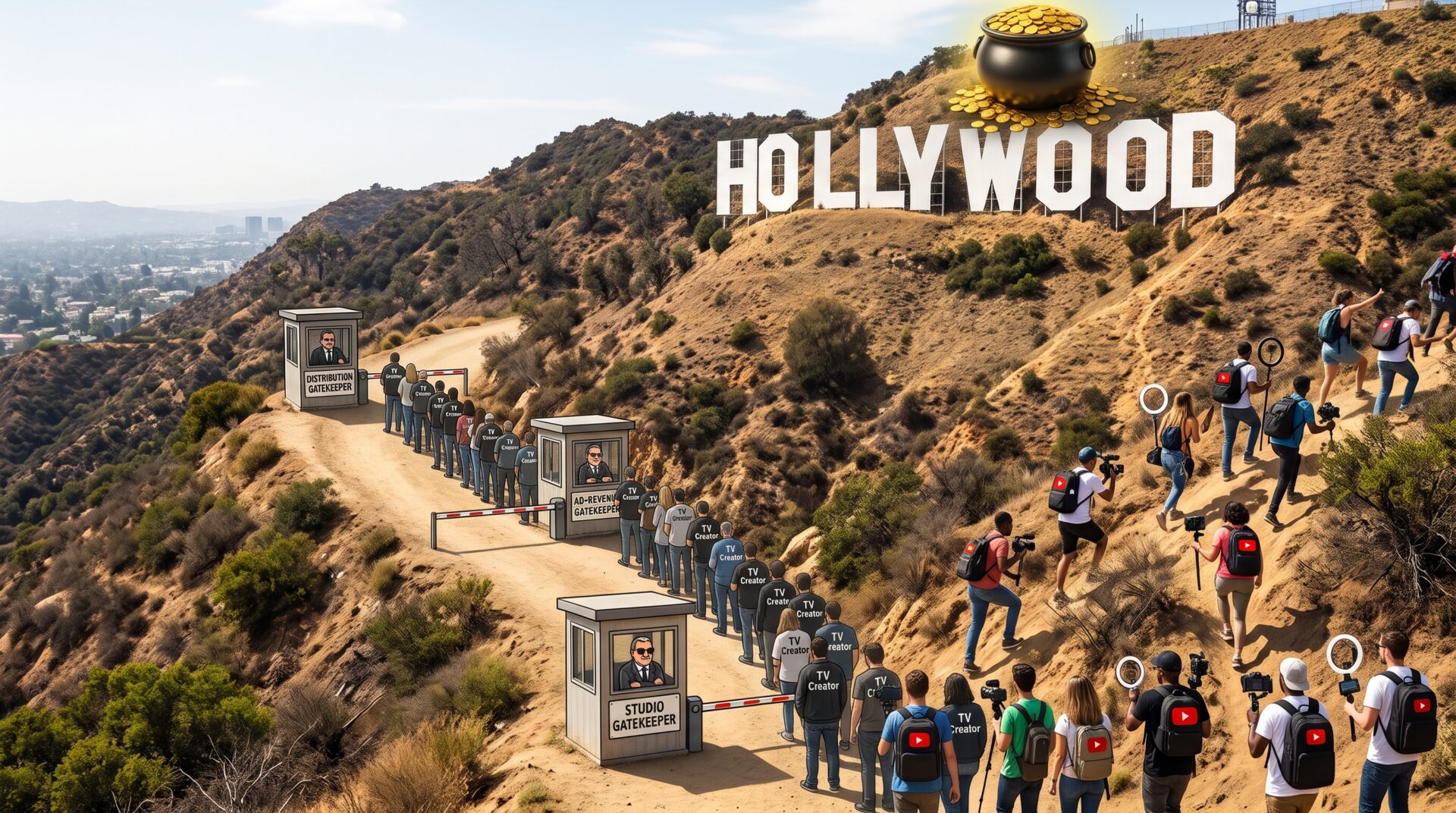
Suddenly, creators could make content, build audiences, distribute directly and monetise without asking permission from the traditional television establishment.
No distribution executive required. No studio relationship required. No endless queue of people demanding a percentage of the revenue.
They simply went direct to the audience.
And here’s the really interesting bit.
While YouTube creators are building businesses, owning their audiences and creating enormous commercial opportunities, many traditional film and television professionals are still standing patiently in the gatekeeper queue.
Waiting for a studio to approve them.
Waiting for a distributor to pick them up.
Waiting for a broadcaster to commission them.
Waiting for somebody else to decide what their work is worth.
Why?
Is it because they genuinely believe the traditional system delivers more value?
Or is it because they would rather be paid by somebody else than take responsibility for becoming genuinely independent?
Perhaps they don’t understand how much more money can be made by owning the relationship with the audience, controlling distribution and retaining more of the monetisation.
Perhaps they simply haven’t realised that the gates are optional.
Of course, going direct isn’t effortless. You need great content, an audience, marketing, distribution infrastructure and a commercial model that works.
But neither is spending years trying to get somebody important to return your telephone call.
And the economics can be considerably more attractive when you’re not sharing the proceeds with an entire procession of middlemen.
The biggest problem facing Hollywood isn’t a shortage of talent, content or money. It’s an industry that has become rather too comfortable controlling access to all three.
The next generation of successful television and film businesses may not be built by the people who get through the gates.
They may be built by the people who walk around them.
So here’s a question for the studios, producers, broadcasters and television executives:
Are you building an independent media business, or are you simply waiting for somebody else to give you permission to have one?
Worth a think.
#Hollywood #FilmIndustry #Television #ContentMonetization #YouTube #StreamingTV #MediaBusiness #ContentIsKing #ViewTV
Check out – View TV Studios
Check out Kapang
Check out Rathergood News