CTV Advertising Problems – There is something quite extraordinary happening in the CTV advertising industry. An advertiser spends $100 buying an audience on a television channel, and somewhere between the advertiser and the television screen, an astonishing number of people suddenly become entitled to a slice of the money.
The only person who seems to have absolutely no idea what happened to the money is the television channel that actually supplied the audience.
Welcome to the wonderful world of adtech.
In the industry, a FAST channel is commonly referred to as a publisher. It is a rather unflattering description for a business that has invested in content, built an audience, secured distribution, paid for technology and created the very advertising opportunities everyone else is apparently so keen to monetise.
Yet ask that publisher a relatively straightforward question: “How much did the advertiser actually pay for the advertising opportunity you just delivered?”
Silence.
Ask how many intermediaries took a commission along the way. More silence.
Ask what percentage of the original advertiser spend eventually reached the publisher. You might as well ask someone to explain quantum physics using a spreadsheet written in ancient Greek.
CTV Advertising Problems start here….!
The commission collectors have arrived
The CTV advertising supply chain has become an elaborate procession of intermediaries, each apparently convinced that its contribution deserves a commission.
There are sales houses, agencies, trading desks, DSPs, SSPs, ad exchanges, ad servers, data providers, verification companies and various other organisations with impressive acronyms and invoices.
Everyone wants their percentage.
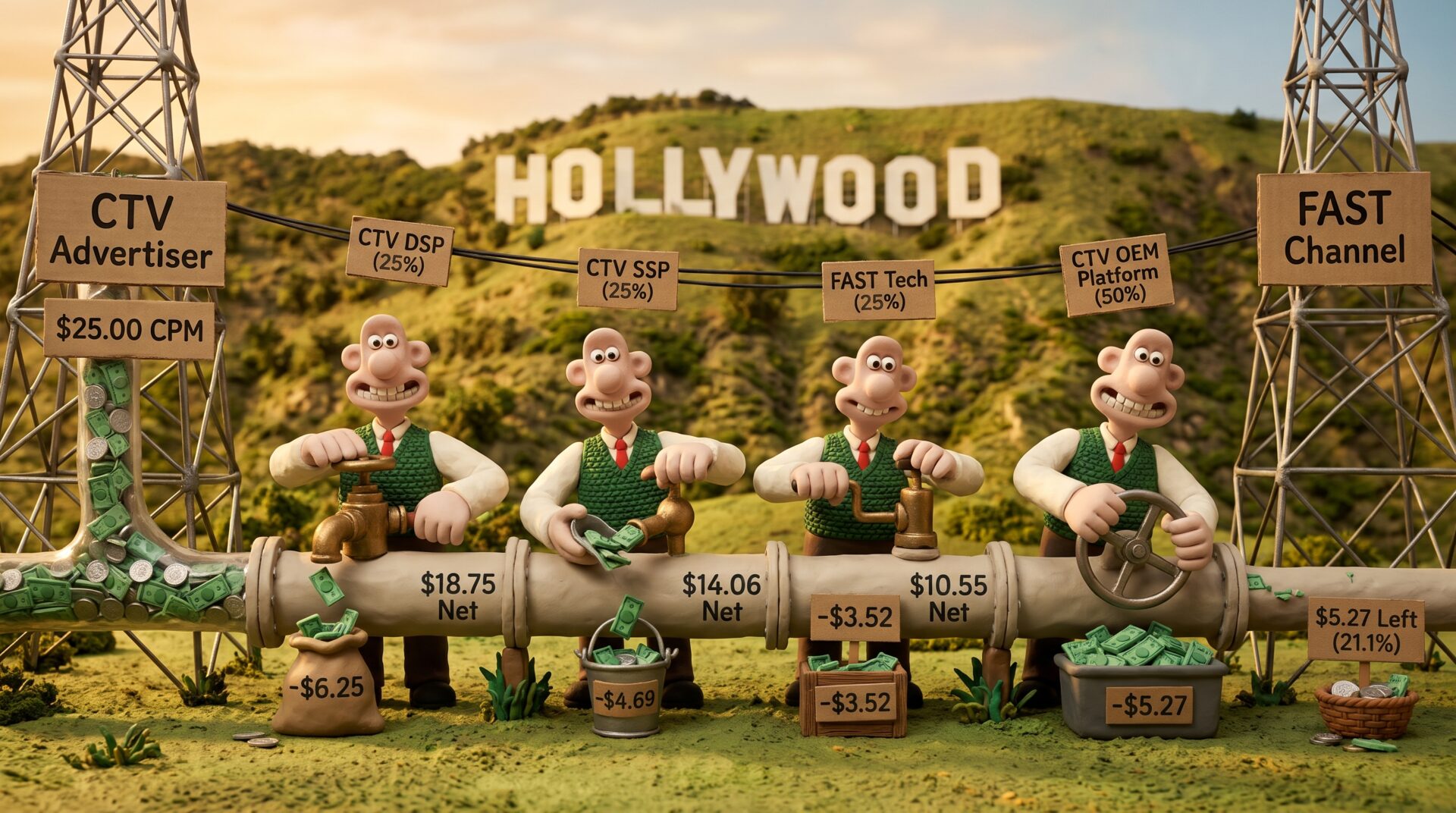
And the extraordinary thing is that commissions can be charged at multiple stages of the transaction. If several parties each take a 20% to 25% cut, the publisher can find itself receiving a fraction of what the advertiser originally spent.
At every stage, somebody is getting paid. But who is actually accountable for the revenue outcome?
Apparently, nobody.
The publisher has no meaningful visibility of the original advertiser CPM, the deductions made by each intermediary, the effective clearing price, or even whether the advertising opportunity was sold at a price that made commercial sense.
It is a remarkably convenient arrangement for everyone except the person providing the inventory.
A commission without a commitment. What could possibly go wrong?
Here is the part that really deserves a standing ovation.
Most of these intermediaries do not commit to selling any particular percentage of a publisher’s available inventory.
They do not guarantee a minimum fill rate. They do not guarantee a minimum CPM. They do not promise to generate a particular amount of revenue.
They simply take a commission on whatever they happen to sell.
Think about that for a moment.
A publisher provides 100,000 advertising opportunities. An intermediary agrees to monetise them, takes its commission on the opportunities it manages to sell, and then walks away from the unsold inventory.
There is no meaningful financial consequence for failing to deliver a commercially acceptable result.
The publisher carries the costs, the infrastructure, the content investment and the audience acquisition. The intermediary carries a sales deck and an invoice.
And somehow, the intermediary believes it is entitled to 25% of the transaction.
If this were any other industry, we might call it an unusual business model.
Where is the performance accountability?
In almost every other commercial relationship, payment is connected to performance.
If you hire somebody to generate revenue, you would reasonably expect them to have some responsibility for the outcome.
If you employ a sales organisation, you might expect it to commit to sales targets. If you engage a distribution partner, you might expect it to guarantee a level of distribution. If you appoint a revenue partner, you might expect that partner to be accountable for the revenue it generates.
CTV advertising seems to have developed an alternative philosophy.
You can take a commission without guaranteeing sales, take a percentage without guaranteeing fill, and collect your money without being particularly concerned about the publisher’s eventual earnings.
Meanwhile, the publisher is left wondering why an industry supposedly experiencing explosive advertising growth is delivering such disappointing economics to the people actually creating the advertising inventory.
The problem isn’t necessarily a lack of advertising demand. It is a lack of transparency, accountability and alignment between the parties involved.
Publishers need to know what their audience is worth
The television industry needs to stop treating publishers as an endless supply of inexpensive advertising inventory.
A channel’s audience has value. Its content has value. Its viewing hours have value. Its advertising opportunities have value.
Publishers should be able to see what advertisers pay, what every intermediary takes, what the actual net revenue is, and what commercial performance is being delivered.
More importantly, they should have a choice.
They should be able to work with transparent revenue-sharing arrangements, guaranteed minimums and performance-based commercial agreements rather than accepting a complicated chain of deductions that nobody seems particularly keen to explain.
The View TV approach: Put the publisher back in control
At View TV, we believe the economics need to change.
Our approach is built around transparent monetisation, accountable delivery and putting the value of the audience back where it belongs.
Through View TV Cloud, we are developing a model that connects broadcasters and content owners directly to advertising demand, with technology costs and commercial deductions made transparent.
Our $100 RPM model takes this further, targeting a guaranteed minimum of $100 per 1,000 viewing hours, equivalent to $0.10 per viewing hour.
That means one million viewing hours can generate $100,000 in revenue under the agreed commercial terms.
No mystery mathematics. No endless chain of unexplained deductions. No pretending that a publisher should be grateful for whatever happens to arrive in its bank account.
CTV advertising should be about monetising audiences, not monetising the number of middlemen between the advertiser and the television screen.
The industry has spent years building increasingly sophisticated technology to sell advertising. Perhaps it is time somebody built a business model that actually makes money for the television channels.
After all, without the publisher, there is no inventory, no audience and ultimately no advertising business.
Perhaps it is time the people creating the value started receiving a fair share of it.
View TV: Better technology. Transparent economics. More revenue for television.