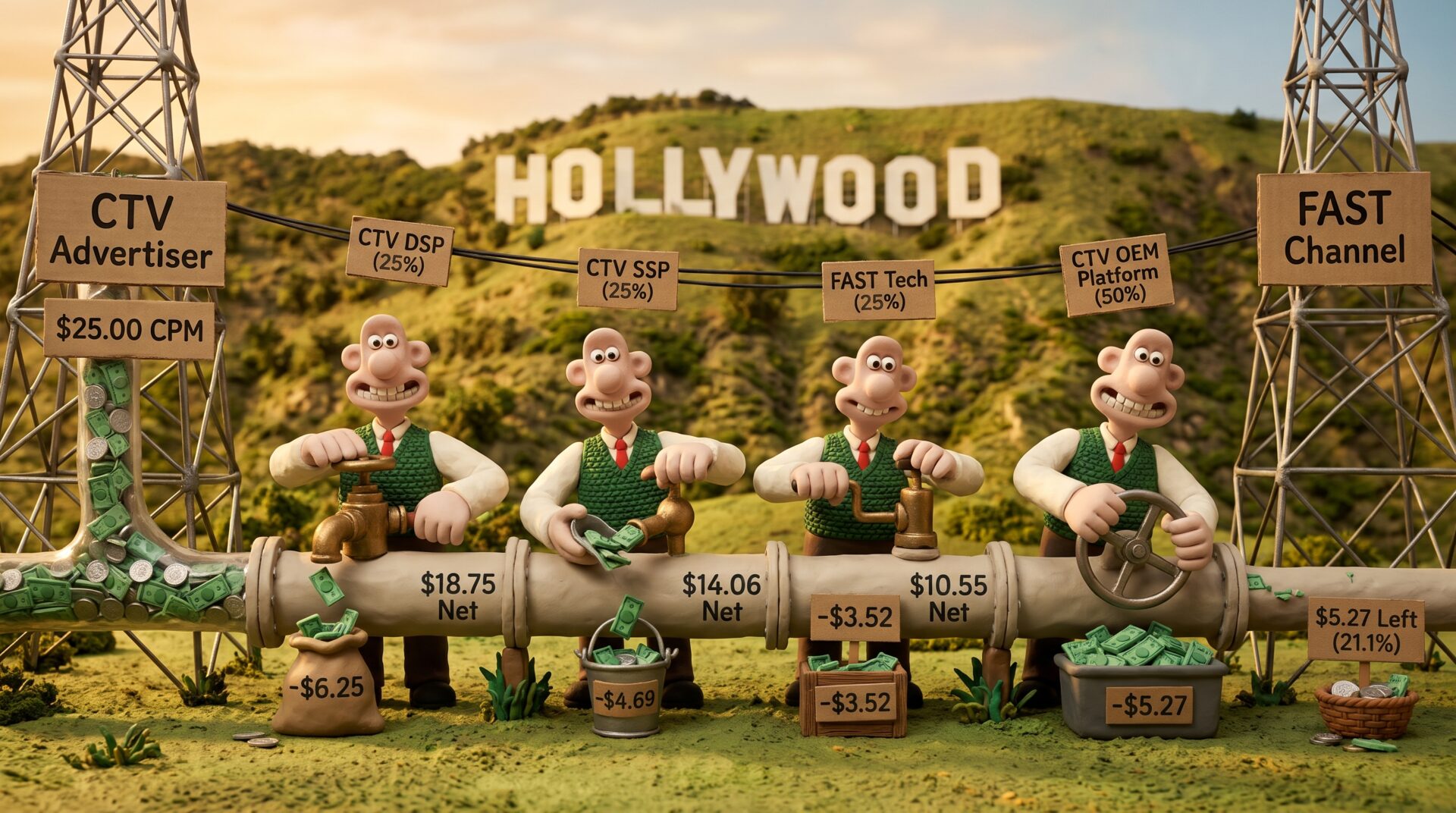
Episodic television and movie libraries were promised a new commercial future through ad-supported streaming.
Instead, many content owners may have unknowingly entered The FAST Channel Trap.
These revenue-sharing arrangements have left them funding the very ecosystem that is now struggling to pay them.
The problem isn’t FAST.
The problem is who controls the money.
There is something rather extraordinary happening in the Connected TV industry.
For years, television studios, independent producers, distributors and movie library owners were told the future of television had arrived. FAST channels were going to change everything. Their libraries, which had spent years generating revenue through licensing and distribution, could now be monetised again. This was to be an entirely new advertising-funded ecosystem.
The FAST Channel Trap promised a scalable, advertiser-supported model that could reprogram revenue streams across licensing, distribution and local markets. Content owners hoped this would unlock repeated monetisation without new licenses. Yet the transition required new metrics, partners and protections to ensure value.
The pitch was irresistible.
Give us your content. We will put it on television platforms. We will build the audience. We will sell the advertising. We will handle the technology. And, in return, we will share the revenue.
No need to negotiate complicated licensing agreements. No need to build your own distribution infrastructure. No need to employ an advertising sales team. Just contribute your library, sit back and collect your share of the advertising revenue.
It sounded rather wonderful.
And, initially, it was.
There was plenty of love bombing, as new channels were being launched and platforms were desperate for programming. Technology companies promised distribution across millions of connected televisions, highlighting the fierce competition for audience reach. This created notable pressure on content owners.
Content owners were being told that their libraries were finally going to become valuable again. Meanwhile, distributors signalled that valued libraries would have renewed licensing terms and broader exposure. The industry hoped the cycle would stabilise revenue. For stakeholders, this promised clarity amid rapid change.
But somewhere along the way, the relationship changed.
The excitement disappeared. The promises became less convincing. The reporting became increasingly difficult to understand. The revenue statements arrived with numbers that barely justified the effort of supplying the content.
And the content owners, having invested their intellectual property into the ecosystem, suddenly found themselves in a rather uncomfortable position.
They had given away the most valuable asset in the entire transaction.
Their content.
1. From Love Bombing to Coercive Control: The FAST Channel Relationship
Let’s be clear. I am using the language of relationships deliberately because there are some uncomfortable similarities between the commercial dynamics of the traditional FAST ecosystem and an unhealthy relationship.
First comes the attention.
Content owners are approached by distributors, aggregators, technology providers and platforms. They are told how valuable their library is, how much distribution is available, how many households they can reach and how exciting the advertising opportunity will become.
Then comes the commitment.
The content owner supplies thousands of hours of programming, frequently under long-term revenue-share arrangements rather than receiving an upfront licensing fee.
Then comes the dependency.
The content is distributed across platforms, advertising is sold through complicated supply chains, and the content owner has little visibility of what advertisers actually spend, what inventory is sold, what fill rates are achieved or how much money disappears between the advertiser and the eventual revenue statement.
Finally, the relationship becomes difficult to leave.
The content owner has already invested the library. They may have signed exclusivity arrangements, built an operating business around the channel, committed resources to playout and distribution, and spent years establishing an audience.
Walking away feels like admitting that the original decision was wrong.
Nobody wants to be the person who tells their investors, board or production partners that the supposedly revolutionary new distribution model has generated a few dollars from millions of views.
So they stay.
They hope next quarter will be better. They hope the platform will increase its advertising sales. They hope the technology provider will improve fill rates. They hope the revenue share will eventually become meaningful.
This is the commercial equivalent of a trauma bond: becoming attached to a system that repeatedly promises improvement but continues to deliver disappointing outcomes.
Of course, not every FAST partnership operates this way, and there are successful operators. But the underlying commercial imbalance deserves considerably more scrutiny than it receives.
The content owner is supplying the product, attracting the audience and creating the reason advertisers want to participate. Yet, in many arrangements, they have the least control over the commercial outcome.
That is a rather extraordinary way to run a television business.
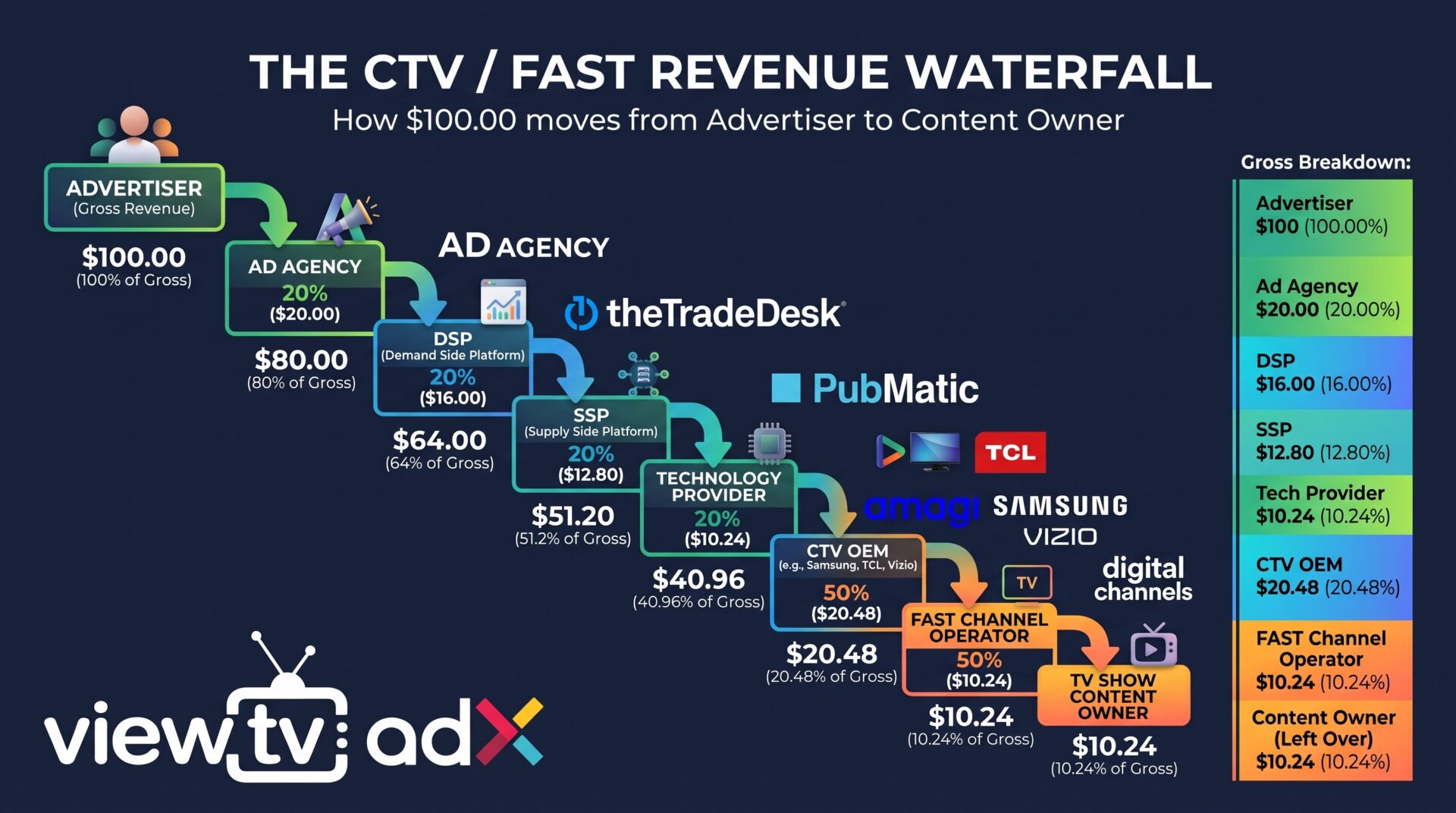
2. Follow the Money: Where Does the $300 RPM Go?
Let’s look at the economics.
The problem with much of the FAST ecosystem is that the revenue being generated by the advertising industry and the revenue eventually reaching the content owner are two very different things.
Consider a representative View TV revenue model.
If advertisers are generating approximately $300 gross advertising revenue per 1,000 hours watched, the economics should be capable of supporting a sustainable television business.
That is $0.30 per viewing hour.
The numbers are significant:
- Gross advertising value: $300 RPM.
- Gross revenue per viewing hour: $0.30.
- Gross advertising value per million hours watched: $300,000.
The uncomfortable question is how much of that $300,000 actually reaches the content owner whose programming attracted the audience?
In an inefficient supply chain, the content owner might receive less than 10% of the original gross advertising value.
That means less than $30,000 from $300,000 in advertising expenditure.
The remaining $270,000 is consumed by some combination of platform economics, distribution arrangements, sales commissions, ad-tech fees, intermediaries, operational costs and other deductions.
Not every dollar retained by an intermediary is profit, of course. Infrastructure, sales, distribution and technology have genuine costs.
But the question is whether the number of commercial hops and the fees attached to them are economically justified.
| Revenue measurement | Amount |
|---|---|
| Advertiser gross spend | $300,000 |
| Content owner receives at 10% | $30,000 |
| Value retained elsewhere | $270,000 |
| Content owner’s share | Less than 10% if below this figure |
The figures above are an illustrative scenario, not an audited industry-wide average.
But they expose the fundamental problem.
If a content owner is generating $300 RPM in gross advertising value and receiving only a fraction of it, the problem isn’t necessarily the demand for advertising.
It is the efficiency of the supply path.

3. The Content Owner Needs $100 RPM. The Industry Is Giving Them a Fraction of That.
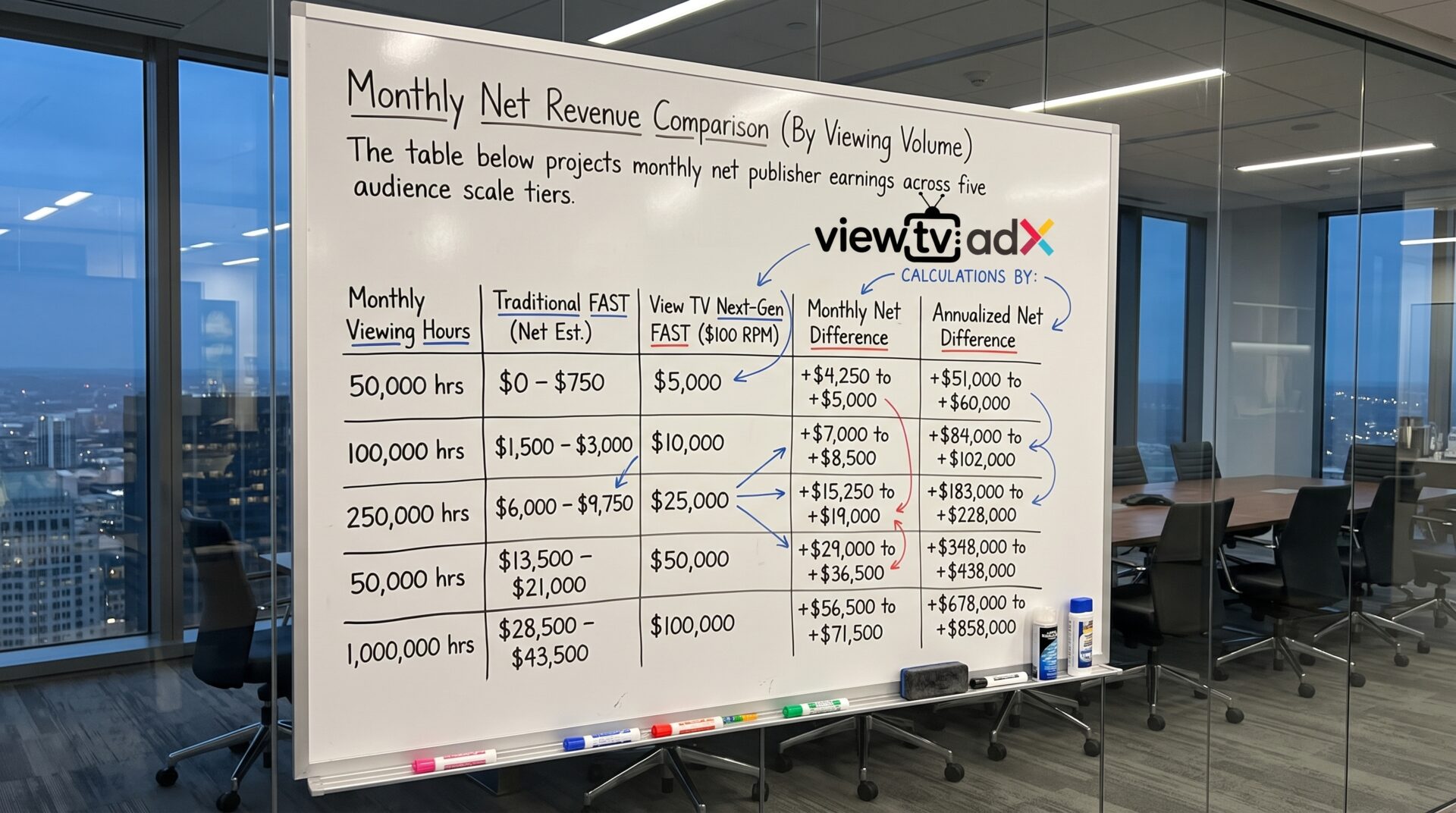
For a library-based television business, a sustainable target should be approximately $100 RPM in net revenue to the content owner.
For premium content, the target should be closer to $200 RPM, reflecting the additional value, exclusivity and commercial opportunities associated with that programming.
These are View TV’s target economics, not claimed industry averages.
Let’s look at the difference.
What content owners should be targeting:
- Library content: $100 RPM.
- Premium content: $200 RPM.
At one million hours watched:
| Content category | Target RPM | Revenue at 1 million hours |
|---|---|---|
| Library content | $100 | $100,000 |
| Premium content | $200 | $200,000 |
Now compare that with a content owner receiving $30,000 from the same million viewing hours.
They are not operating a sustainable television business.
They are effectively subsidising an advertising supply chain.
And the irony is that the advertising industry needs their content to generate those viewing hours in the first place.
Without the programming, there is no audience.
Without the audience, there is no advertising inventory.
Without the advertising inventory, there is no programmatic revenue.
Yet somehow, the party creating the fundamental commercial asset is expected to accept whatever happens to trickle down.
That is not a particularly clever business model.
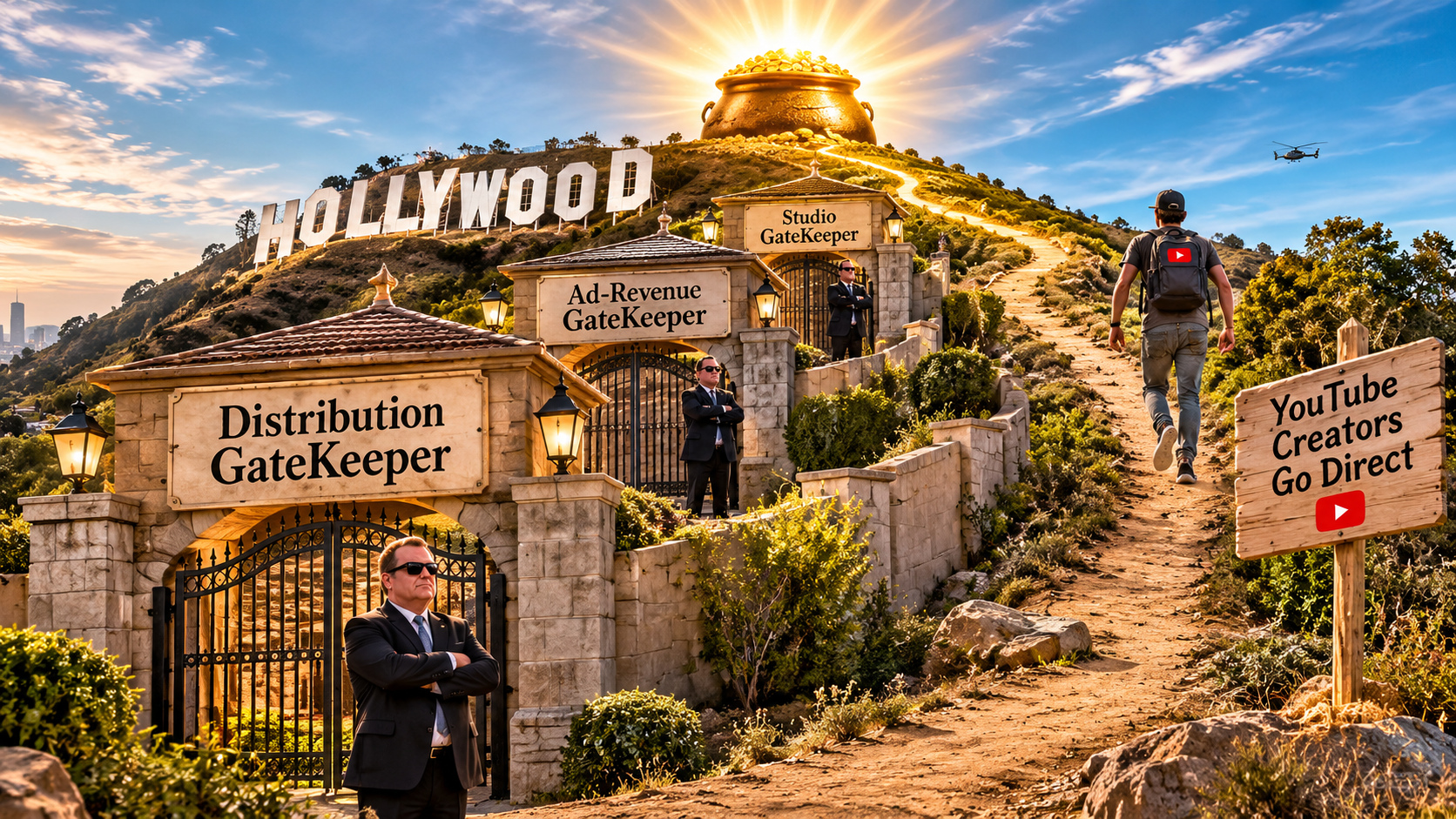
4. The Advertising Supply Chain Has Become a Motorway With Too Many Toll Booths
The original promise of programmatic advertising was efficiency.
An advertiser could use a DSP to identify an audience, select inventory, submit a bid and deliver an advertisement automatically.
Simple enough.
But look at what has happened to the Connected TV supply chain.
A typical transaction can involve:
- Advertiser and agency.
- Demand-side platform (DSP).
- Multiple exchanges and resellers.
- SSPs and supply aggregators.
- FAST channel distributors.
- Ad-server providers.
- SSAI providers.
- Measurement and verification providers.
- Platform or OEM revenue-sharing arrangements.
- Content owners.
Each participant has a commercial justification for being involved.
But every additional hop introduces the possibility of another fee, another commission, another margin and another opportunity for the original advertising value to become diluted.
Some technology providers charge SaaS fees. Others take a percentage of advertising revenue. Others combine both.
It is not unusual for the commercial arrangements to involve percentages in the 15%-30% range at individual stages, although the actual charges vary significantly by provider and contract.
And this is where the economics become ridiculous.
Why should the broadcaster pay for an advertising technology system whose primary commercial purpose is to facilitate the advertiser’s ability to buy advertising?
Why should the broadcaster pay multiple technology companies to receive the money generated by its own inventory?
Why should a content owner bear the commercial risk when the advertising supply chain fails to deliver the expected fill rate?
And perhaps the biggest question:
Why is the party creating the audience not in control of the revenue?
In an AI-powered world, there is absolutely no reason why the process cannot be considerably more efficient.
The DSP should be able to transact directly with the broadcaster’s advertising supply platform.
The FAST channel broadcaster should be capable of acting as the SSP, in the IAB sense, controlling the available inventory, managing the advertising rules and exposing its supply directly to the demand market.
For on-demand content, the equivalent should be an audience platform with direct monetisation capability.
Technology should connect the parties, not create an endless procession of toll booths between them.

5. The Industry Has Confused Distribution With Ownership of an Audience
This is perhaps the biggest mistake content owners made.
They were told that distribution was everything.
Get onto Samsung TV Plus, Pluto TV, TCL, Plex, VIZIO, Tubi and the other major platforms, and the audience would follow.
But being distributed on a platform does not mean you own the audience.
It means you have access to an audience through somebody else’s distribution relationship.
That distinction is commercially enormous.
A FAST channel may have millions of potential household impressions available through an OEM or streaming platform, but if it cannot see meaningful first-party audience data, control its advertising relationships, understand its revenue and market itself independently, its commercial value remains dependent on that distribution agreement.
And when the distribution partner changes its priorities, its economics or its channel line-up, what happens?
The content owner is left negotiating from a position of weakness.
The channel might have a substantial library, a recognisable brand and years of programming, but its actual commercial value is being determined by somebody else.
This is why the traditional television model worked differently.
Cable channel operators understood that distribution was important, but they also understood that the channel was a commercial business.
They controlled programming, built audiences, developed advertising relationships and used the revenue to market the channel and improve the content.
They did not simply hand over the entire commercial relationship and hope somebody else would send them a cheque.
The next generation of streaming television needs to return to that principle.
Distribution is a route to the audience. It is not the business itself.
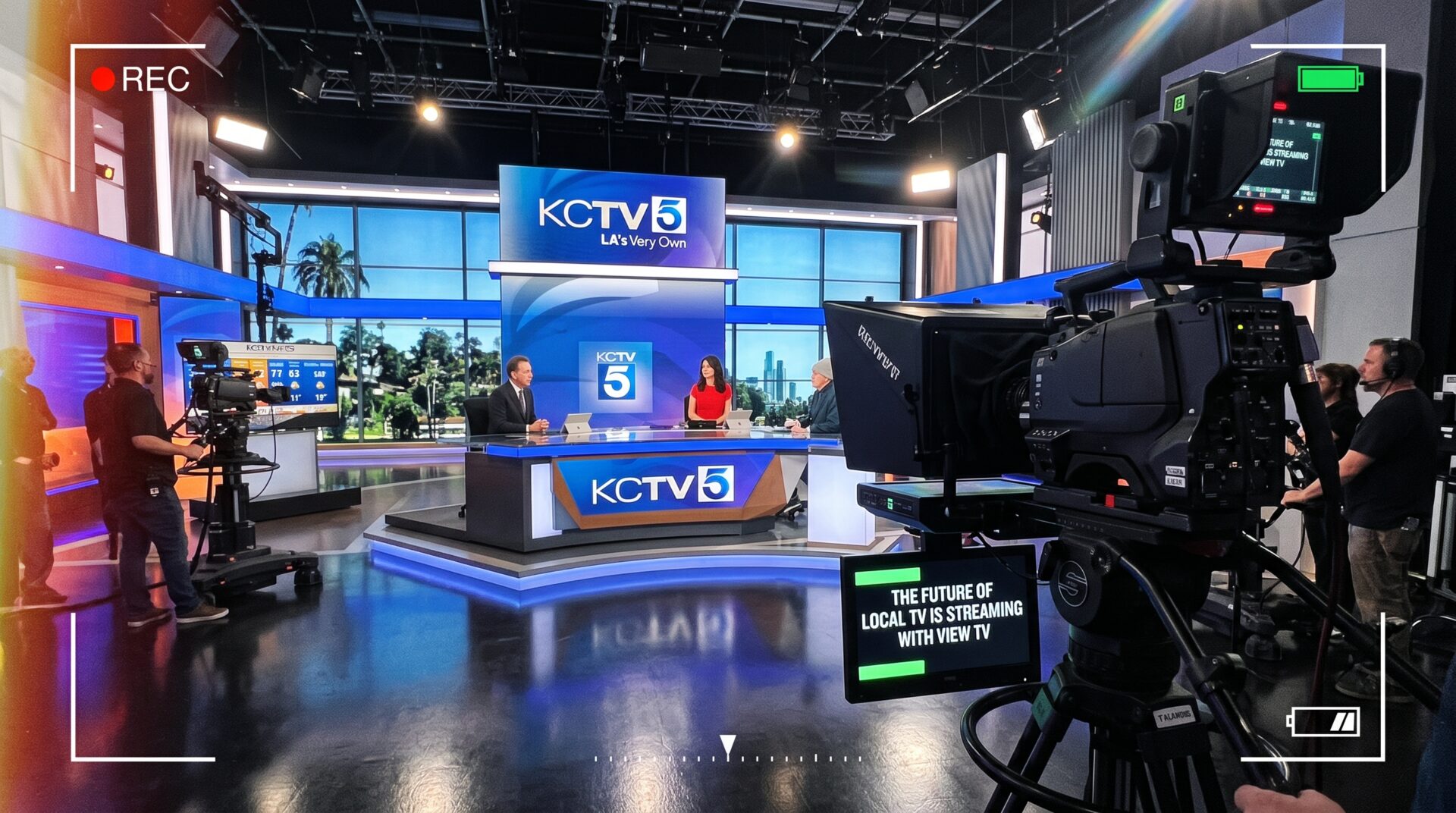
6. Audiences Were Promised Freeview. Instead, They Got the Leftovers.
There is another problem that the industry is beginning to discover.
Audiences did not move to connected television because they wanted thousands of channels containing programming that nobody particularly wanted to watch.
They moved because they expected a better television experience.
They expected the convenience of on-demand streaming, the simplicity of traditional television, the quality of premium entertainment and the ability to access live programming without paying for multiple expensive subscriptions.
Essentially, they expected a better version of Freeview, delivered through the internet.
Instead, a significant part of the FAST ecosystem has become a dumping ground for content that is difficult to monetise elsewhere.
The race to launch more channels has often taken priority over building channels people actually want to watch.
And this has created a vicious circle:
- Weak libraries attract limited audiences.
- Limited audiences generate lower advertising demand.
- Lower advertising demand creates weaker content-owner revenues.
- Weak revenues prevent investment in better programming.
- Poor programming gives audiences even less reason to return.
Meanwhile, the programming that audiences actually want is increasingly difficult to find in free ad-supported environments.
Live sports. Live local news. National news. Exclusive entertainment. Premium episodic television.
These are the formats that create appointment viewing, habitual consumption and valuable advertising opportunities.
The audience is not necessarily rejecting ad-supported television.
It is rejecting a poor television experience.
And when the experience becomes frustrating, viewers vote with their feet.
They pay for a subscription. They switch platforms. Or they head straight to YouTube.
7. YouTube Has Understood Something That Television Studios Haven’t
Here is another rather uncomfortable comparison.
YouTube has created an ecosystem where independent creators can build enormous audiences, develop brands and generate commercial relationships around their programming.
Does YouTube pay creators enough advertising revenue to fund every production?
Not necessarily.
But successful creators have discovered something that much of the traditional television industry seems to have forgotten.
The content itself is a commercial asset that can be monetised in multiple ways.
They use branded entertainment, product placement, sponsorship, integrations, merchandise, affiliate relationships and direct commercial partnerships.
Advertising revenue is only one component of the business.
Look at the economics of a successful creator-led production.
A brand might sponsor an episode. A product might be integrated into the programme. A commercial partner might fund an entire production series.
The creator is no longer relying entirely on the advertising platform to make the numbers work.
Yet many television and film studios continue to approach ad-supported streaming as though the only available revenue stream is the programmatic advertising impression.
That is astonishing.
Consider what happens when you combine the following:
- $15 CPM programmatic advertising.
- 20 or more advertising impressions per viewing hour.
- Brand integrations.
- Product placement.
- Series sponsorship.
- Shoppable entertainment.
- Direct advertiser relationships.
Suddenly, the commercial opportunity becomes considerably more interesting.
A television programme should not have to rely on a single advertising revenue stream to justify its production costs.
It should be a monetisation platform in its own right.

8. The $200,000 Episodic Television Opportunity
Let’s take a hypothetical premium episodic television production costing $200,000 per episode.
Under the traditional production model, the studio might require a substantial licensing agreement, broadcaster commitment or subscription platform deal to justify that investment.
But consider the potential of a properly monetised ad-funded television model.
Assume:
- Production cost: $200,000 per episode.
- Programmatic advertising CPM: $15.
- Advertising opportunities: 20 per viewing hour.
- Full advertising delivery for the simplified calculation.
- Additional sponsorship and brand integration revenue.
The potential gross programmatic advertising value is $300 per 1,000 viewing hours.
At one million viewing hours:
1,000 × $300 = $300,000.
The production could therefore generate $300,000 in gross programmatic advertising value from one million viewing hours.
But gross advertising value is not production revenue. Fill, actual sold impressions, invalid traffic, platform shares, technology fees and other deductions all matter.
Now consider the View TV target of $200 RPM for premium content.
| Hours watched | Premium content revenue |
|---|---|
| 250,000 | $50,000 |
| 500,000 | $100,000 |
| 750,000 | $150,000 |
| 1,000,000 | $200,000 |
| 1,500,000 | $300,000 |
At $200 RPM, one million hours would generate $200,000 towards the production economics.
At 500,000 hours, $100,000 would be generated, leaving $100,000 to recover through sponsorship, brand integrations, other distribution windows or additional monetisation.
This is where the model becomes interesting.
A $200,000 episode should not necessarily require ten million viewing hours to recover its production cost.
The industry needs to stop confusing inefficient monetisation with an inherent inability to monetise television content.
The opportunity is not simply to get more viewers.
It is to extract more commercial value from every viewing hour.
9. Next-Generation FAST: Stop Making Broadcasters Pay to Get Paid
This is where View TV believes the entire model needs to change.
We call it View TV Next-Generation FAST.
The underlying philosophy is simple.
The broadcaster and content owner should not be paying for the advertising technology required to monetise their content.
Ad-tech exists to facilitate advertising.
The advertiser wants access to audiences. The DSP is doing the hard work of bringing advertiser demand into the market. The broadcaster is supplying the inventory and the audience.
Why should the broadcaster have to pay several technology providers, often through both SaaS charges and revenue-share deductions, just to receive its advertising revenue?
The commercial model needs turning upside down.
Under the View TV Next-Generation FAST proposition:
- Content owners retain control of their intellectual property.
- Broadcasters control their advertising inventory and revenue.
- Advertising demand connects directly through a more transparent supply path.
- Technology is consolidated rather than duplicated across multiple commercial intermediaries.
- Revenue is measured against viewing hours and actual monetisation.
- Ad-fill performance becomes a measurable commercial responsibility.
- Channels receive predictable revenue rather than opaque statements.
- Revenue can be reinvested into content, marketing and audience growth.
The objective is to remove unnecessary layers between the advertiser and the broadcaster.
Not every intermediary needs to disappear. Genuine services deserve to be paid.
But every participant should have to justify its position in the supply chain through measurable value.
If a technology provider cannot deliver the contracted service, it should not simply continue collecting fees while the content owner absorbs the financial consequences.
The commercial incentives need to be aligned.

10. Introducing View TV ADX: Bringing the Commercial Ecosystem Under One Roof
View TV has developed View TV ADX to address precisely this problem.
It brings together the components required to connect advertisers, broadcasters, platforms and content owners through a more efficient monetisation ecosystem.
Rather than forcing broadcasters to stitch together multiple commercial and technical providers, View TV ADX is designed to connect the revenue-generating parts of the television business.
This includes:
| Component | Commercial purpose |
|---|---|
| View TV Ads | Direct advertising sales and targeted CTV buying |
| View TV Marketplace | Programmatic CTV advertising exchange |
| ONE SSP | CTV supply-side monetisation |
| View TV Cloud | CDN, encoding, SSAI, ad serving and analytics |
| View TV Play | Cloud broadcast playout and channel management |
| View TV BrandWorks | Brand integrations, sponsorship and product placement |
| View TV ADX | Connecting the advertising, audience and content monetisation ecosystem |
The objective is not simply to deliver another advertising technology platform.
It is to change the economics of the relationship between the advertiser and the content owner.
Advertisers get a more transparent supply path and selective targeting opportunities.
Broadcasters get greater control over their inventory and revenue.
Platforms get better monetisation economics.
Content owners receive a more meaningful return on the intellectual property that brought the audience into the ecosystem.
And critically, broadcasters can build predictable revenue models that support investment in better programming.
11. The Content Owner Needs to Ask Some Uncomfortable Questions
For anyone currently operating a FAST channel or licensing an episodic or movie library into a revenue-share arrangement, there are some questions worth asking.
Not next year.
Now.
Commercial transparency
- What is the actual gross advertising revenue generated by my content?
- What is the gross RPM per 1,000 hours watched?
- What is the net RPM actually reaching me?
- What percentage of advertising revenue is retained by every intermediary?
- How much inventory is being sold versus left unfilled?
Ownership and control
- Who owns the first-party audience data?
- Who controls the advertising inventory?
- Can I access alternative distribution and monetisation partners?
- Am I tied into exclusivity that prevents me from improving my revenues?
- Who controls the commercial relationship with advertisers?
Sustainability
- Is my content generating enough money to justify its continued availability?
- Is the revenue sufficient to fund new content acquisition and production?
- Am I paying for technology that should be funded by advertising demand?
- What happens if the platform changes its revenue-share terms?
- Can I demonstrate a credible return on investment to my shareholders and content partners?
If the answers are unclear, that should be a warning.
And if the business is generating substantial viewing hours but negligible content-owner revenue, it is time to investigate the economics rather than simply celebrate the audience figures.
That does not automatically mean terminating a distribution agreement.
It means understanding the contractual restrictions, rights ownership, termination provisions, audience value and alternative commercial options before deciding whether to renegotiate, migrate or leave.
12. There Will Be Winners and Losers. That Is the Point.
The next stage of Connected TV will not be won by the companies that have the most channels, the most logos on their website or the largest number of distribution agreements.
It will be won by the companies that understand the economics of television.
And that means some existing business models will have to change.
There are companies in the current ecosystem making substantial money from technology fees, distribution margins and advertising commissions.
They will naturally defend the existing model.
But if the content owner can generate $300 in gross advertising value and only receive a fraction of it, something has to give.
If the broadcaster can remove unnecessary technology costs and improve its net revenue, it will.
If the advertiser can reach the same audience through a more transparent supply path, it will.
If the content owner can earn $100 RPM instead of $10 or $20, it will certainly take notice.
There will be losers.
And the losers will largely be those commercial intermediaries whose business models depend on extracting value from a supply chain that has become unnecessarily complicated.
That is not an attack on technology.
It is an argument for better technology, better economics and fewer unnecessary commercial toll booths.
13. Content Is King. Content Is in Control.
The biggest mistake the FAST industry made was convincing content owners that distribution was the prize.
It isn’t.
The prize is the commercial value of the audience.
The content owner brings the intellectual property. The programming creates the audience. The audience creates the advertising opportunity.
Everything else is infrastructure.
And infrastructure should enable the business, not consume the business.
For too long, content owners have been told to be grateful for distribution, grateful for exposure and grateful for whatever revenue happens to arrive at the end of the month.
That relationship needs to end.
The future of television is predominantly ad-funded, with the ability to upgrade audiences into subscription services for premium content and experiences.
But that future will only work if the economics are sustainable for the people creating the programming.
We cannot expect studios to invest in premium episodic television, independent producers to finance original entertainment or broadcasters to deliver live sports and news if the revenue model only supports the technology providers sitting between the advertiser and the audience.
The industry needs to return to the fundamentals.
Content. Audience. Revenue. Technology.
Not technology first, distribution second and content owners somewhere at the bottom hoping for a cheque.
View TV Next-Generation FAST turns that model around.
The content owner is no longer simply supplying the bait that attracts an audience for somebody else’s advertising business.
They become an active participant in the commercial value of their own content.
They have a route to better monetisation, greater transparency and more predictable revenue.
And they have a choice.
They can continue accepting the economics of the old ecosystem, hoping that somebody eventually improves the revenue share.
Or they can recognise that the industry has changed, that the technology now exists to do things differently and that they do not have to remain financially dependent on an arrangement that may no longer serve their interests.
The question is no longer whether FAST channels can generate advertising revenue.
The question is why the people who created the audience are receiving so little of it.
And perhaps the most important question of all:
How many content owners are going to wait until their libraries have been completely devalued before they realise they have the power to change the relationship?
Content is King.
Content is in Control.
And it is time the money started following it.