The audience comes for the content. The advertising industry takes the money. The content owner gets what is left.
There is a fundamental problem holding back the growth of FAST channels, Free Ad-Supported Streaming TV and ad-supported Video on Demand.
It is not a lack of audiences.
It is not a lack of content.
It is not a lack of advertising opportunities.
It is an inefficient CTV Advertising Supply Chain Problem: a layered, complicated, and commercially fragmented system. As a result, the people creating value are increasingly disconnected from the money it generates.
The industry has spent years building an advertising technology ecosystem around advertising distribution. It has focused less on the value of the content and audiences that make advertising possible.
And somewhere along the way, we have forgotten something rather important.
Nobody switches on a television to watch an SSP. Nobody subscribes to a streaming service because of a DSP. Nobody opens a FAST channel to enjoy an ad-tech intermediary.
They come for the content.
Yet the content owner is often at the end of a long commercial queue, watching everyone else take a slice of the advertising revenue.
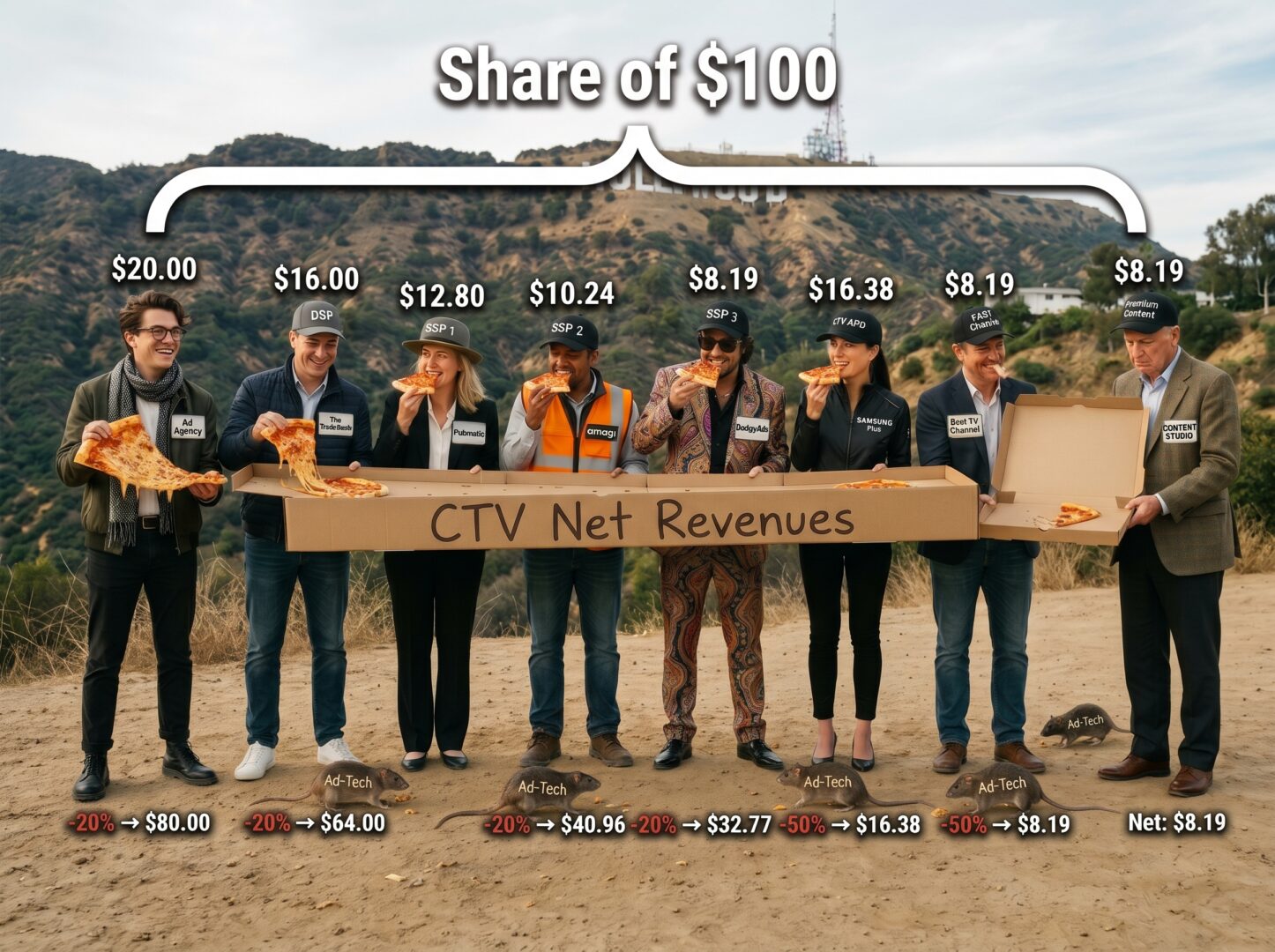
The CTV advertising supply chain: everyone wants a slice of the pizza
Imagine a pizza box labeled CTV Net Revenues.
It starts with the advertiser’s money and passes through a succession of businesses, each providing a service, each with its own commercial model and each expecting to be paid.
The journey might look something like this:
- Ad Agency: Manages the advertiser relationship, campaign planning and media buying.
- The Trade Desk / DSP: Provides demand-side technology to identify and purchase advertising inventory.
- PubMatic / SSP 1: Provides supply-side access and auction services.
- Amagi / SSP 2: Another potential technology or supply-path layer.
- Another Ad-Tech Provider / SSP 3: An additional intermediary in the transaction.
- Samsung Plus / CTV App: Provides the audience platform, distribution environment and access to viewers.
- The FAST Channel and Content Owner: Provides the programming that attracted the audience in the first place.
These are illustrative roles in a possible supply path, not a claim that every advertising transaction passes through these particular businesses. They also do not claim that every company performs the same function.
The problem is the cumulative economics.
Every additional intermediary needs a reason to exist. Every additional technology layer needs to demonstrate the value it creates. Every additional commercial deduction reduces the amount available to fund content, develop channels, and build sustainable streaming businesses.
The question should not simply be how many intermediaries can participate in an advertising transaction.
It should be:
How much incremental value does each intermediary create, and is that value worth the cost?
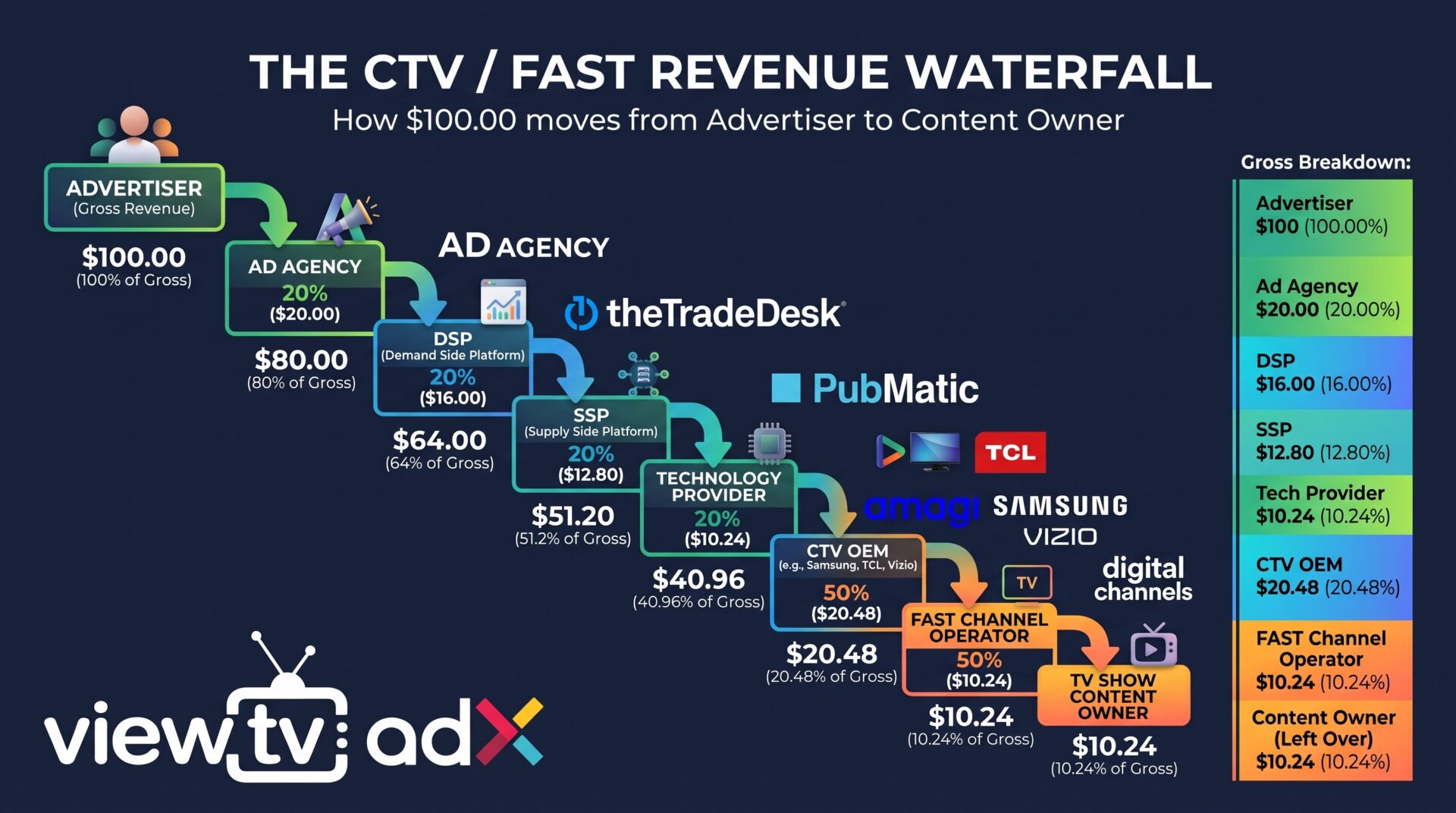
Let’s follow $100 through the advertising supply chain
Consider an illustrative advertiser budget of $100.
For this calculation, apply each deduction sequentially to the remaining amount. These hypothetical percentages demonstrate the cumulative effect of multiple commercial layers. They are not industry averages or published fees from the companies mentioned above.
| Supply chain participant | Illustrative deduction | Money remaining |
|---|---|---|
| Advertiser’s media budget | $100.00 | $100.00 |
| Ad Agency | 10% | $90.00 |
| DSP | 15% | $76.50 |
| SSP 1 | 10% | $68.85 |
| SSP 2 | 10% | $61.97 |
| SSP 3 | 10% | $55.77 |
| CTV Audience Platform | 20% | $44.61 |
| Content owner receives | $44.61 |
Illustrative calculation only. Actual fees, auction dynamics, platform agreements, revenue shares, taxes, and other deductions vary. The model applies each percentage to the balance remaining after the previous deduction.
The result?
Out of the original $100, the content owner receives approximately $44.61.
The other $55.39 has been allocated to the various stages of the hypothetical supply chain.
That is the problem with an unnecessarily complicated advertising pathway.
The advertiser may believe they have invested $100 in television advertising. The content owner may believe they are monetizing valuable viewing hours. But the amount reaching the content business can differ substantially from the advertiser’s original media spend.
This is before considering content acquisition, production, licensing, channel operations, encoding, distribution, CDN delivery, compliance, and management costs.
What happens when you scale this across millions of advertising dollars?
The difference becomes much more significant.
| Advertiser media spend | Content owner at 44.61% | Content owner at 61.20% |
|---|---|---|
| $100 | $44.61 | $61.20 |
| $10,000 | $4,461 | $6,120 |
| $100,000 | $44,615 | $61,200 |
| $1,000,000 | $446,148 | $612,000 |
| $10,000,000 | $4,461,480 | $6,120,000 |
The second column represents the illustrative multi-intermediary model above.
The third represents a simplified direct model, explained below. Both use the same assumed agency, DSP and audience-platform economics.
At $1 million of advertising spend, the difference is approximately $165,852.
At $10 million, it is approximately $1.66 million.
That is money that could potentially be reinvested into content acquisition, original productions, channel development, audience growth and better programming.
This is not a small operational detail. It is a structural question about whether the economics of streaming television can support the businesses responsible for making it.
The biggest mistake: treating content as an interchangeable commodity
The advertising industry often talks about inventory, impressions, bid requests, supply paths, CPMs, fill rates and programmatic efficiency.
All of those things matter.
But the conversation can become so focused on the mechanics of advertising that the underlying product is forgotten.
A viewer watching a premium television series is not simply generating an impression.
They are consuming intellectual property, a production, a story, a sporting event, a documentary, or a piece of entertainment. Somebody invested time, money, and expertise to create it.
That content is the reason the audience is there.
Without it, the advertising opportunity does not exist.
A FAST channel with a loyal audience and valuable programming deserves distinct treatment, not treatment as another interchangeable source of inventory. Likewise, advertisers should view an ad-supported VOD catalog as more than video files waiting for insertion into an auction.
The value of the audience is connected to the value of the content.
Yet the commercial structures often reward the distribution and technology layers more consistently than the content businesses themselves.
That is short-term thinking.
If content owners cannot generate a sustainable return, they will eventually reduce investment or withdraw their libraries. They may also change distribution strategies or seek alternative monetization models.
And when that happens, the entire advertising ecosystem loses the very thing it needs to survive.
The multiplication problem: why FAST and AVOD economics matter
Let’s look at the impact on viewing hours.
Suppose a FAST channel generates one million hours of viewing in a month.
At a hypothetical $20 net RPM, the content business generates:
1,000,000 viewing hours ÷ 1,000 × $20 = $20,000
At a $50 net RPM:
1,000,000 ÷ 1,000 × $50 = $50,000
At a $100 net RPM:
1,000,000 ÷ 1,000 × $100 = $100,000
RPM here means net revenue per 1,000 viewing hours, not CPM per 1,000 ad impressions. These scenarios illustrate revenue; they do not predict what every channel will earn.
Now consider a portfolio of 20 channels, each generating one million viewing hours per month.
| Net RPM | Monthly revenue per channel | Monthly portfolio revenue |
|---|---|---|
| $20 | $20,000 | $400,000 |
| $50 | $50,000 | $1,000,000 |
| $100 | $100,000 | $2,000,000 |
The difference between $20 RPM and $100 RPM is $1.6 million every month across that portfolio.
That is the difference between operating a business that struggles to fund its content and one that has a meaningful opportunity to reinvest in its audience and programming.
The point is not that every channel can automatically achieve $100 RPM. Audience geography, genre, advertiser demand, fill, ad load, seasonality, device mix, content suitability, and commercial terms all matter.
The point is that the net economics must be designed into the business model from the beginning.
A channel can have millions of viewing hours and still be commercially unsustainable if too much of its advertising value disappears before reaching the content owner.
More viewing hours do not automatically solve a broken supply chain.
In fact, increasing viewing hours through an inefficient supply path can simply mean generating more revenue for everyone else.
CTV ADX: put the DSP directly in front of the audience platform and content owner
This is where View TV takes a different approach.
CTV ADX is designed to simplify the CTV advertising supply path by connecting demand-side platforms directly with participating audience platforms and content owners.
Rather than requiring every advertising opportunity to travel through multiple overlapping SSPs and additional supply intermediaries, CTV ADX provides a more direct commercial and technology connection.
The objective is to remove unnecessary layers between demand and supply.
The simplified pathway becomes:
Advertiser → Ad Agency → DSP → CTV ADX → Audience Platform and Content Owner
The DSP gets access to eligible CTV inventory through CTV ADX.
The audience platform gets a direct route to advertising demand.
The content owner gets a clearer route to monetization.
The transaction can be managed with greater transparency around inventory, delivery, reporting and commercial allocation.
This does not mean every agency, DSP, or platform fee disappears. Nor does it mean every campaign will have identical economics. Instead, the supply path does not need multiple additional SSP layers simply because the industry has historically structured it that way.
The difference in the illustrative $100 calculation
Let’s retain the same assumptions for a fair comparison:
- Advertiser media budget: $100
- Agency deduction: 10%
- DSP deduction: 15%
- Audience platform share: 20% of the remaining amount
- No additional SSP 1, SSP 2 or SSP 3 deductions in the simplified direct pathway
The calculation becomes:
| Stage | Amount |
|---|---|
| Advertiser media budget | $100.00 |
| After agency deduction | $90.00 |
| After DSP deduction | $76.50 |
| Audience platform share (20%) | $15.30 |
| Content owner allocation (80%) | $61.20 |
Under these illustrative assumptions, the content owner receives $61.20 rather than $44.61.
That is an additional $16.59 for every $100 of original advertising spend.
It represents approximately 37.2% more revenue for the content owner compared with the multi-intermediary example.
At $1 million in advertiser spend, that is approximately $165,852 in additional content-owner allocation.
At $10 million, it is approximately $1.66 million.
The benefit is not created by inventing more advertising inventory or increasing the number of ads shown to viewers.
It comes from simplifying the route through which advertising money reaches the businesses providing the content and audience.
That is a much more sustainable way to think about CTV monetization.
Why the audience platform matters just as much as the content owner
There is another important part of this equation.
The audience platform also provides real value.
CTV platforms, OEMs, streaming applications and distribution partners invest in the technology, user experience, device integration, audience acquisition and delivery infrastructure that make viewing possible.
They need a sustainable commercial return too.
The answer is not to remove the audience platform from the equation. Instead, create a model where the audience platform and content owner can both share in the value they create. This avoids unnecessary intermediaries taking additional slices along the way.
CTV ADX is designed around that principle.
It connects the DSP to the audience platform and content owner through a more direct advertising pathway. This improves transparency and reduces avoidable supply-chain costs.
The audience platform remains commercially important.
The content owner remains commercially important.
The advertiser gets access to the audience.
And the technology exists to connect those participants, rather than becoming another layer that extracts value simply because it sits in the middle.
Why the industry needs to change its thinking about FAST channels
FAST has created an enormous opportunity for content owners.
Libraries that may have struggled to find new distribution opportunities can now reach audiences through connected televisions, streaming applications and ad-supported channels.
But distribution alone does not create a sustainable business.
Launching a channel is relatively easy compared with building a commercially viable channel.
The real questions are:
- How many hours are being watched?
- Who is watching?
- Where is the audience located?
- What advertising demand is available?
- What is the net revenue per 1,000 viewing hours?
- How much of the advertising value reaches the content owner?
- What does it cost to operate and distribute the channel?
- Can the channel reinvest in better content?
The same applies to ad-supported VOD.
A library of thousands of hours is not automatically a successful business. It needs discovery, audience engagement, and advertising demand. It also needs effective monetization and a commercial structure that works for the rights holder.
If every participant in the supply chain focuses on maximizing their own short-term margin, the content business eventually becomes the weakest part of the model.
And that is completely backwards.
The next generation of CTV needs to be built around CART
At View TV, we believe sustainable television requires four connected components:
Content. Audience. Revenue. Technology.
This is the CART principle.
Content: The programming that gives viewers a reason to watch.
Audience: The people who choose to watch that content, across connected televisions, streaming applications and other distribution environments.
Revenue: The advertising, sponsorship, licensing, brand integration and additional commercial opportunities that fund the business.
Technology: The infrastructure that enables content delivery, playout, advertising, measurement and monetization efficiently.
The order matters.
Technology should support the business model. It should not dictate the business model.
Advertising should fund the content. It should not consume so much of the economics that the content owner cannot afford to continue supplying it.
Distribution should expand the audience. It should not become an endless chain of toll booths.
And revenue should be measured by what the content business actually receives, not simply by the gross advertising spend passing through the ecosystem.
The future is fewer unnecessary intermediaries and more value reaching content
The CTV industry does not need another layer of complexity.
It needs better economics.
It needs advertising pathways that are transparent, efficient and accountable.
It needs audience platforms that can access demand directly.
It needs content owners who can understand the value of their viewing hours and participate fairly in the revenue they generate.
And it needs technology providers that recognize their role is to enable the ecosystem, not to make the ecosystem dependent on an ever-growing number of deductions.
CTV ADX is built around the CTV Advertising Supply Chain Problem: connecting DSP demand directly with audience platforms and content owners. This reduces unnecessary supply-path complexity and creates a more sustainable route for advertising revenue.
Because the real opportunity in Streaming TV is not simply to launch more channels.
It is to make those channels commercially sustainable.
Stop building an advertising supply chain that eats the content budget.
Stop rewarding the number of intermediaries instead of the value they create.
Stop treating content owners as the last people who should get paid.
The audience is there because of the content.
The advertising money is there because of the audience.
It is time the economics reflected that.
Content is King. The audience is the asset. CTV ADX connects the demand directly to the people who deliver it.
View TV is building the next generation of sustainable Streaming TV around that principle.