CTV Hop Tax – How the programmatic advertising industry allowed intermediaries to multiply, revenue to disappear and the very people funding television content to become the least rewarded participants in the advertising chain.
However, there is a fundamental problem with the economics of CTV Hop Tax in Connected TV advertising.
The industry has been reluctant to confront it.
Moreover, the advertising industry has built an increasingly complicated ecosystem around what should be a relatively straightforward commercial transaction.
An advertiser wants to reach an audience watching television.
Additionally, the advertiser buys advertising through a Demand-Side Platform (DSP) and CTV Hop Tax.
That demand is matched with available inventory through a Supply-Side Platform (SSP).
It ultimately delivers advertising revenue to the television channel or content owner.
At its simplest, the commercial chain has four principal participants:
- The Advertiser: Provides the money and wants to reach an audience.
- The DSP: Represents the buying side and manages advertising demand.
- The SSP: Represents the selling side and connects demand with available advertising inventory.
- The CTV Channel: Owns or controls the content, audience relationship and advertising inventory.
That is the basic commercial proposition.
However, somewhere along the way, the industry decided that one SSP was not necessarily enough.
In a recent analysis of CTV trading paths, ONE SSP identified advertising impressions passing through as many as five or six different SSPs before reaching the broadcaster or content owner.
The question is simple: what exactly are all these additional companies doing to justify their participation?
And, more importantly, who is paying for them?
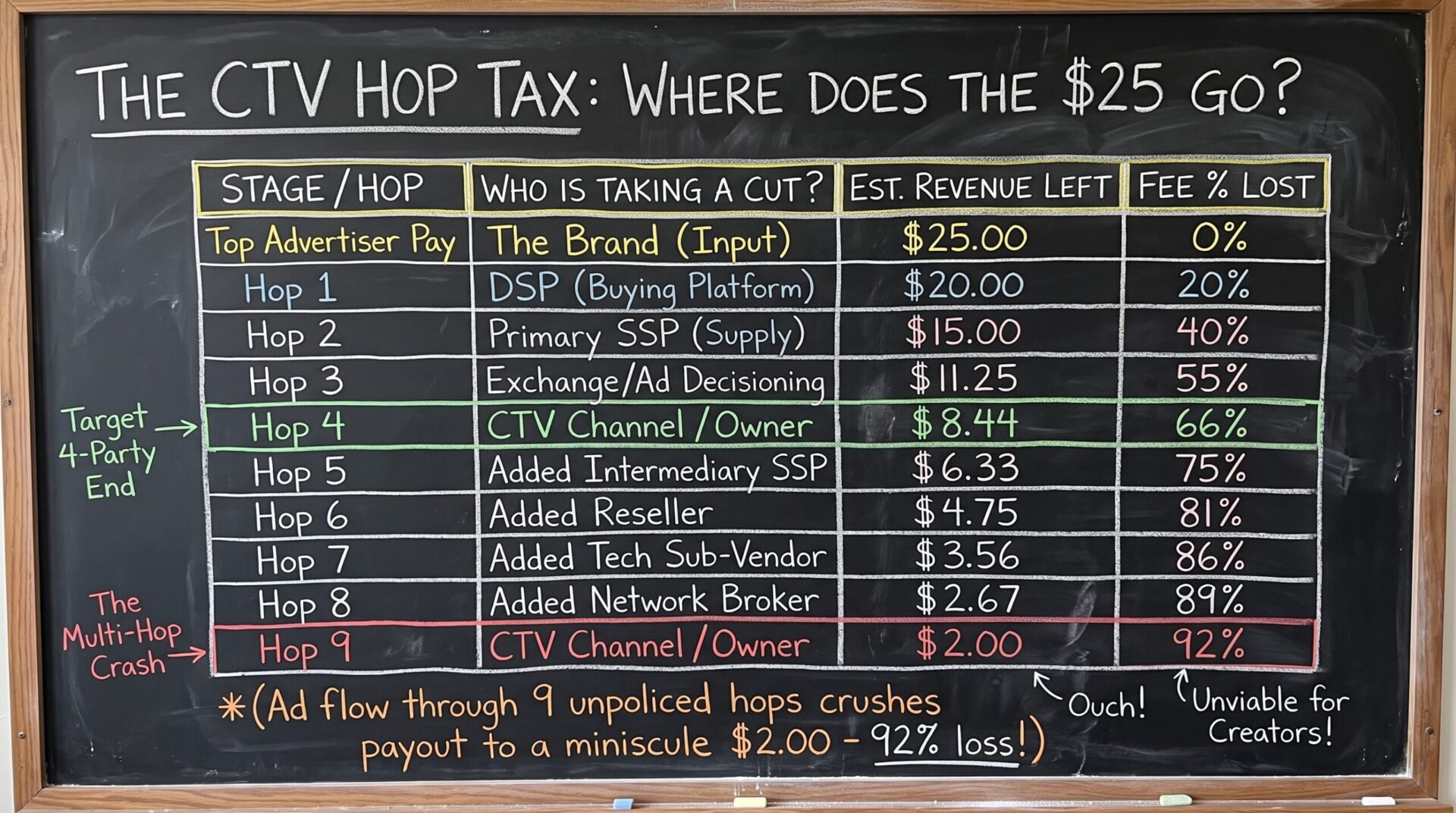
The nine-hop problem: Where does the advertising money go?
The traditional argument for programmatic advertising is that technology creates efficiency. Automated trading connects advertisers with audiences, improves targeting, increases competition and makes inventory easier to buy.
There is legitimate value in that proposition.
But adding another intermediary does not automatically create additional value.
Every additional participant potentially introduces another technology fee, another data transformation, another reporting layer and another opportunity for the original advertising investment to be diluted.
Consider an advertiser purchasing CTV advertising at a $25 CPM.
If every intermediary in the illustrative transaction chain retains 30% of the remaining advertising value, the financial impact becomes significant very quickly.
The $25 CPM revenue waterfall
The following model illustrates the cumulative effect of a 30% deduction at each successive intermediary. Moreover, it is an example of compounding deductions, not a claim that every SSP charges a universal 30% fee.
| Supply-chain deductions | CPM remaining | Revenue retained |
|---|---|---|
| Advertiser pays | $25.00 | 100% |
| 1 hop | $17.50 | 70% |
| 2 hops | $12.25 | 49% |
| 3 hops | $8.58 | 34.3% |
| 4 hops | $6.00 | 24.0% |
| 5 hops | $4.20 | 16.8% |
| 6 hops | $2.94 | 11.8% |
| 7 hops | $2.06 | 8.2% |
| 8 hops | $1.44 | 5.8% |
| 9 hops | $1.01 | 4.0% |
Illustrative model: each successive intermediary retains 30% of the amount passed to it. Figures rounded.
At four deductions, the original $25 CPM has become approximately $6.
At nine deductions, the remaining value is approximately $1.01.
The original advertiser has spent $25, yet the publisher or channel may ultimately receive only a fraction of that investment.
This is the problem with an industry that measures success by the volume of transactions rather than the value reaching the content owner.
The actual economics vary considerably between platforms, contractual arrangements, technology fees and trading paths. The point is that every additional fee must be justified by measurable value.
And the industry has not always been particularly good at demonstrating that value.

This is not just an allegation: The industry has documented the problem
The Association of National Advertisers (ANA) published its Programmatic Media Supply Chain Transparency Study in December 2023.
The study examined $123 million in advertising spend and 35.5 billion impressions.
Its findings were particularly revealing.
- 29% of the advertising dollar entering the DSP was attributed to transaction costs, primarily DSP and SSP fees.
- Another 35% was attributed to media productivity losses, including non-viewable and invalid traffic.
- Only 36 cents of every dollar entering the DSP effectively reached the consumer through media that met the study’s quality requirements.
Agency fees were outside the scope of the study.
This is a significant finding because it demonstrates that the problem is not simply about how many companies are involved. It is about how much money is lost between the original advertising investment and the delivery of a valuable advertising impression.
The IAB has also developed standards including ads.text, sellers.json and the OpenRTB SupplyChain Object to improve visibility into who is selling and reselling advertising inventory.
These standards are important. Buyers should be able to see the parties involved in a transaction.
But transparency alone does not guarantee economic efficiency.
Knowing that nine companies have participated in a transaction does not mean that nine companies were necessary.
The problem with five SSPs in one advertising transaction
The purpose of an SSP is to help publishers monetise their advertising inventory.
It should connect inventory to demand, facilitate competition, improve yield, provide reporting and help ensure that the advertising is delivered correctly.
There are legitimate reasons for multiple SSP relationships.
Different SSPs may provide different advertiser relationships, geographical coverage, demand sources, identity solutions or specialised capabilities.
The problem begins when multiple SSPs are not providing genuinely incremental demand but are simply reselling access to the same inventory.
This creates several problems.
1. Revenue dilution
Every additional commercial intermediary potentially introduces another fee. The content owner receives less of the original advertiser investment without necessarily receiving additional audience value.
2. Data degradation
Every additional layer can introduce another opportunity for audience information, impression identifiers, targeting signals and reporting data to be transformed, restricted or disconnected from their original context.
The result can be a less reliable picture of the actual audience being purchased.
3. Reduced accountability
When an advertiser, DSP, multiple SSPs, an ad server and a broadcaster are all involved, it becomes increasingly difficult to establish who is responsible for the quality, delivery and economics of the impression.
4. Unpredictable revenue
The broadcaster is left relying on auction outcomes, fill rates, seasonal demand, intermediary fees and the commercial arrangements of companies it may never have selected.
This is hardly an attractive investment proposition for a television channel owner.
The biggest irony: The content owner carries the investment risk
There is one participant at the end of this advertising funnel that is often overlooked.
The content owner.
They invest in acquiring content rights, commissioning original productions, licensing programming, creating channels, building brands, marketing audiences and maintaining the infrastructure required to deliver television.
They are responsible for creating the reason an audience turns on the television in the first place.
Without the content, there is no audience.
Without the audience, there is no advertising inventory.
Without the advertising inventory, there is no programmatic transaction.
Yet the content owner can end up being the participant with the least visibility over the final advertising economics.
The technology companies are paid for facilitating transactions. Moreover, the content owner hopes that enough money moves through the chain. Therefore, this money must justify the original investment.
That is not a sustainable television business model.
So why did the IAB allow this to happen?
It is important to distinguish between the IAB’s role and the commercial behaviour of the advertising industry.
The IAB and IAB Tech Lab develop industry standards, technical specifications and guidance. They are not statutory advertising regulators, and they do not have the authority to set universal SSP fees, prohibit commercial intermediaries or enforce a particular revenue-sharing arrangement.
The industry has therefore developed through a combination of commercial competition, voluntary standards, private contractual relationships and fragmented accountability.
The IAB has made important contributions to supply-chain transparency, including the development of sellers.json and the OpenRTB SupplyChain Object.
But there is a difference between establishing a standard that allows participants to identify every intermediary and establishing commercial rules that prevent unnecessary intermediaries from extracting value.
The latter is not the IAB’s regulatory mandate.
The real question should be directed at the industry itself:
Why have advertisers, agencies, DSPs and publishers accepted a system where the number of intermediaries can increase without a corresponding requirement to demonstrate incremental value?
Why should a content owner accept five SSPs between its inventory and the advertiser when a more direct transaction might achieve the same result?
And why should the broadcaster be expected to absorb the commercial consequences?
The industry needs to move beyond measuring the number of transactions and start measuring the actual economics of the content.
The Next Generation FAST model: Stop selling a percentage of an unknown number
At View TV, we believe the answer is to fundamentally change the way CTV channel inventory is monetised.
Our Next Generation FAST model is designed around a simple principle:
The channel owner should know what their audience is worth before they invest in building it.
Rather than leaving the broadcaster dependent on variable programmatic fill, average CPMs, seasonal advertising demand and multiple intermediary deductions, View TV introduces a fixed, pre-agreed NET revenue floor.
We purchase the advertising inventory destined for the television channel in advance, establishing a defined commercial value for the hours viewed.
The model uses an RPM (Revenue Per Mille Hours Viewed) rather than relying exclusively on the CPM achieved by individual advertising impressions.
Our target commercial model is:
$100 NET RPM per 1,000 hours viewed.
This means the channel owner has a transparent, measurable revenue expectation based on actual viewing.
What does $100 RPM mean for a channel?
| Monthly hours viewed | NET RPM | Channel revenue |
|---|---|---|
| 100,000 | $100 | $10,000 |
| 250,000 | $100 | $25,000 |
| 400,000 | $100 | $40,000 |
| 500,000 | $100 | $50,000 |
| 750,000 | $100 | $75,000 |
| 1,000,000 | $100 | $100,000 |
| 2,000,000 | $100 | $200,000 |
| 5,000,000 | $100 | $500,000 |
This changes the investment proposition.
A channel generating one million hours of viewing can forecast $100,000 in NET advertising revenue under the agreed $100 RPM commercial arrangement.
The channel does not have to speculate on whether the average CPM will be $15, $20 or $25, whether the advertising market is in a seasonal downturn, or whether an additional SSP has been introduced into the trading path.
The commercial floor is established in advance.
The broadcaster knows what it earns for its audience.
View TV takes responsibility for the monetisation proposition rather than simply passing an advertising tag to a channel and hoping the market delivers.
From advertising fill to predictable television economics
This is not an argument against programmatic advertising.
Programmatic advertising has an important role in connecting advertisers with television audiences.
It is an argument against unnecessary complexity and the assumption that every additional technology provider deserves another percentage of the advertising dollar.
Our model is built around several principles:
1. Defined NET revenue
The channel receives an agreed revenue rate based on hours viewed, rather than an unpredictable share of an opaque advertising waterfall.
2. Advance inventory purchasing
View TV establishes the commercial value of the advertising inventory in advance, reducing the channel owner’s exposure to variable advertising yields.
3. First-party audience intelligence
View TV can use its direct audience and platform data to understand who is watching, when they are watching and what content is attracting attention.
This provides the foundation for more informed advertising decisions and addressable-style targeting.
4. AI-assisted audience intelligence
AI-driven macro audience population and classification can help build richer audience profiles, improving how advertising opportunities are packaged, matched and sold.
The objective is to make more of the available inventory commercially useful, rather than simply increasing the number of intermediaries.
5. A transparent revenue relationship
The channel owner has a defined commercial relationship with View TV and a measurable revenue calculation.
The objective is straightforward: more value should reach the people creating and delivering the content.
Television needs to return to a content-first investment model
The future of CTV cannot be built on a system where technology intermediaries become the primary beneficiaries of television advertising.
The industry needs to recognise that content is not simply another commodity travelling through a digital advertising exchange.
It is the reason the entire ecosystem exists.
The next generation of television businesses must reward content investment, audience development and the creation of quality programming.
We should be measuring Hours Viewed × RPM = Revenue.
Not the number of SSPs in the transaction.
Not the number of advertising exchanges involved.
Not how many technology companies can insert themselves between the advertiser and the television channel.
And certainly not how much revenue can be removed before the content owner gets paid.
At View TV, we believe the next generation of FAST should be built on predictable economics, transparent revenue and a direct relationship between audience value and content investment.
If a television channel generates one million hours of viewing, its owner should be able to understand exactly what that audience is worth.
That is what Next Generation FAST is designed to deliver.
Because the future of television should be about rewarding the people who create the audience, not the people who keep inserting themselves between the audience and the advertiser.
Content is King. It is time the economics reflected it.